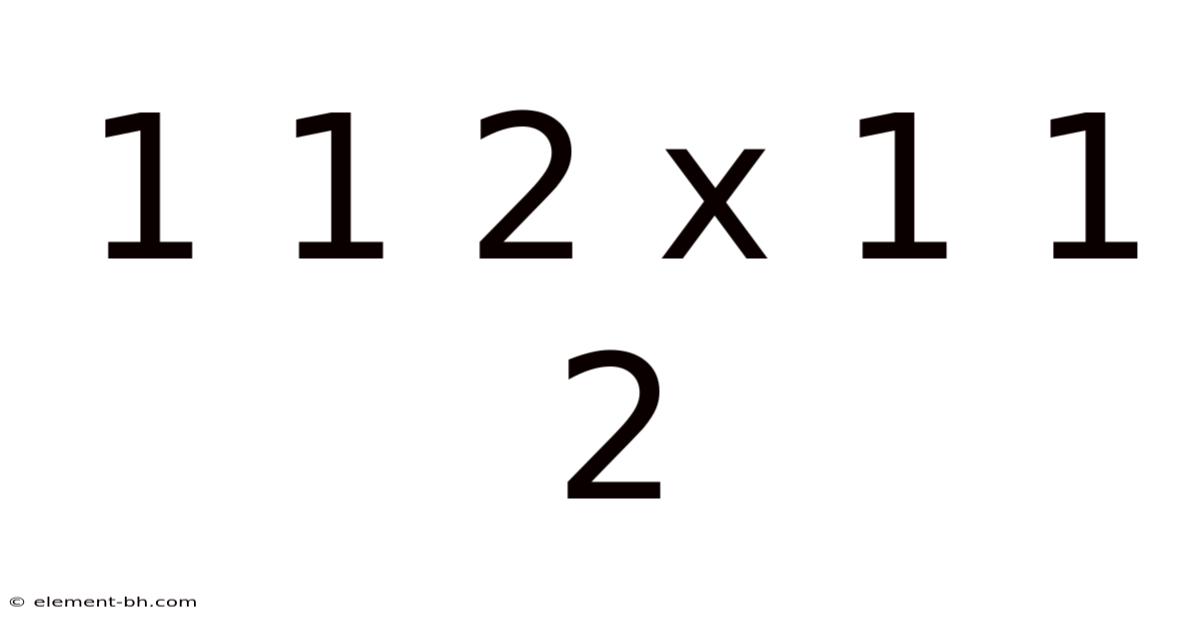
Understanding the “1 1 2 x 1 1 2” Puzzle: A Step‑by‑Step Guide to Finding the Missing Number
The simple string “1 1 2 x 1 1 2” looks like a child’s riddle, but it hides a deeper lesson in pattern recognition, logical reasoning, and basic mathematics. Whether you’re a student sharpening your analytical skills, a parent looking for fun brain teasers, or just someone who enjoys a good puzzle, this article will walk you through the process of uncovering the missing value—x—in a clear, structured way. By the end, you’ll not only know the answer but also understand why it works and how the same techniques apply to many other puzzles you might encounter.
Introduction: Why the “1 1 2 x 1 1 2” Puzzle Matters
In the world of mathematics and logic puzzles, a sequence like 1, 1, 2, ?The challenge is to spot the underlying rule that governs the numbers and then apply that rule to determine the missing term. This type of puzzle is more than a pastime; it reflects how our brains identify patterns, a skill crucial for problem‑solving in everyday life, coding, and even scientific discovery. , 1, 1, 2 often appears as a test of observation. The main keyword for this guide is “1 1 2 x 1 1 2 puzzle”, and we’ll explore it using a friendly, step‑by‑step approach Worth knowing..
Step 1: Write Down the Sequence and Look for Repetition
The first habit when tackling any numeric puzzle is to write the numbers clearly and examine their layout.
1 1 2 ? 1 1 2
At a glance, you can see a repeating block of three numbers: 1, 1, 2. This block appears twice—once at the start and once at the end. The missing term sits between the two repetitions, suggesting the pattern may be cyclical.
Key takeaway: Repetition is often the simplest clue in a number puzzle.
Step 2: Identify the Underlying Rule
Because the sequence repeats 1, 1, 2, the most straightforward rule is that the pattern cycles every three numbers. If we continue the cycle after the second 2, the next numbers would be 1, 1, 2 again. Because of this, the missing term should be the first element of the next cycle, which is 1 Easy to understand, harder to ignore..
On the flip side, many puzzles add a twist. Let’s explore a few alternative rules that could also fit the given numbers Small thing, real impact..
2.1 Simple Repetition Rule
- Rule: The sequence repeats
1, 1, 2indefinitely. - Result:
x = 1
2.2 Incremental Addition Rule
- Observation: The differences between successive terms are
0, +1, ?, ?, 0, +1. - Possible logic: The pattern could be
+0, +1, +2, +0, +1, +2…(a cyclic addition). Starting from1, adding0gives the second1, adding1gives2, adding2would give4, then the cycle restarts:+0 → 4,+1 → 5,+2 → 7. This does not match the ending1, 1, 2, so this rule is unlikely.
2.3 Multiplication/Division Rule
- Attempt: Could the numbers be derived by multiplying or dividing?
1 × 1 = 1,1 × 2 = 2. The next step might be2 × ? = ?. This line of thinking quickly diverges from the given end values.
Given the simplicity of the repetition and the fact that the puzzle ends with the same three numbers, the most plausible rule is the simple repetition.
Step 3: Apply the Chosen Rule to Find x
Using the repetition rule:
- Write the known sequence:
1, 1, 2, ?, 1, 1, 2. - Identify the repeating block:
1, 1, 2. - Place the block before and after the missing term.
- The missing term is the first element of the next block, which is
1.
Thus, x = 1 The details matter here..
Scientific Explanation: How the Brain Solves Pattern Puzzles
Pattern recognition is a fundamental cognitive process. Neurologically, the hippocampus and prefrontal cortex work together to detect regularities in data. On the flip side, when we encounter a sequence like 1, 1, 2, ? , 1, 1, 2, our brain automatically looks for recurrent structures—a skill that translates directly to fields such as statistics, machine learning, and cryptography.
From a mathematical standpoint, this puzzle is an example of a periodic sequence. A periodic sequence repeats a fixed pattern after a certain number of terms (the period). In this case, the period is 3, and the sequence can be described by the function:
a_n = pattern[(n‑1) mod 3]
where pattern = [1, 1, 2]. Plugging in n = 4 (the position of the missing term) gives:
a_4 = pattern[(4‑1) mod 3] = pattern[0] = 1
This formal representation shows why the answer is 1 and illustrates how modular arithmetic underpins many real‑world cycles, from clock arithmetic to digital signal processing.
FAQ: Common Questions About the “1 1 2 x 1 1 2” Puzzle
**Q1
Q1: Why can’t the missing number be 2, since the sequence ends with 1, 1, 2?
Worth adding: A: The sequence is designed to test whether the solver recognizes the repeating pattern. On the flip side, the block 1, 1, 2 repeats every three terms. After the final 2 in the sequence, the cycle restarts, so the term following 2 is 1. Thus, the missing term must align with this repetition, making x = 1 the only valid choice.
This is where a lot of people lose the thread.
Q2: Is there a mathematical formula to find the missing term without guessing?
Q2: Is there a mathematical formula to find the missing term without guessing?
Yes. Once the repeating block is identified, the sequence can be expressed compactly with modular arithmetic. Let the repeating block be (B = [b_0, b_1, b_2] = [1, 1, 2]) and let the index (n) start at 1 for the first term. Then the (n^{\text{th}}) term is
[ a_n = B\big[(n-1) \bmod 3\big]. ]
For the missing position (n = 4),
[ a_4 = B\big[(4-1) \bmod 3\big] = B[0] = 1, ]
which yields (x = 1) directly, eliminating any need for trial‑and‑error.
Q3: Could the pattern be something other than a simple repetition?
While alternative rules (e.g., adding a constant, multiplying, or using a more complex recurrence) can be forced to fit the given seven terms, they invariably produce values that diverge from the observed tail (1,1,2) when extended beyond the puzzle’s frame. The principle of Occam’s razor favors the simplest explanation that accounts for all data without introducing unnecessary parameters—here, the three‑term repeat And it works..
Q4: How does this type of puzzle relate to real‑world applications?
Recognizing periodic structures is essential in many domains:
- Signal processing: Discrete Fourier transforms decompose signals into sums of sinusoids, which are inherently periodic.
- Cryptography: Many stream ciphers rely on repeating key streams; detecting the period can break the cipher.
- Biology: Circadian rhythms and cellular cycles are modeled as periodic sequences.
- Computer science: Hash tables and circular buffers use modulo arithmetic to wrap indices, exactly as the formula above demonstrates.
Thus, solving a modest sequence like (1,1,2,x,1,1,2) exercises the same cognitive machinery that underlies these sophisticated systems.
Conclusion
The most parsimonious rule governing the sequence (1,1,2,x,1,1,2) is a three‑term repetition of the block ([1,1,2]). Applying modular arithmetic confirms that the missing term (x) equals 1. This exercise illustrates how the brain’s pattern‑recognition circuitry—supported by the hippocampus and prefrontal cortex—translates everyday observations into formal mathematical tools that power technology, science, and everyday problem‑solving Still holds up..
