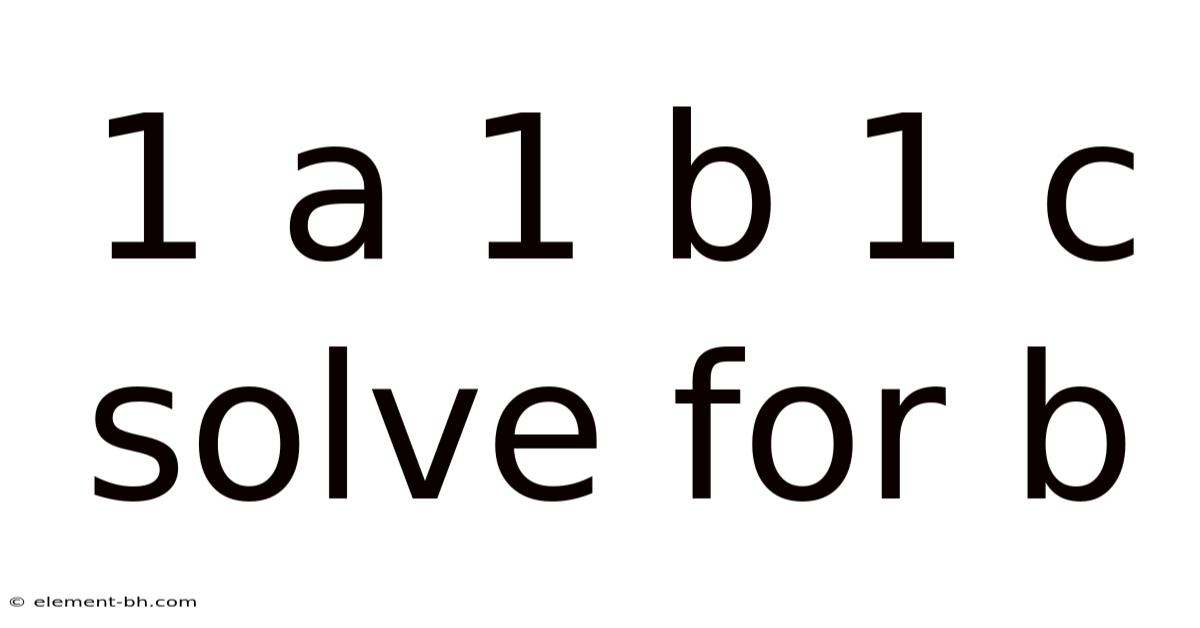
When you encounter a simple linear equation like 1a + 1b + 1c = S, solving for b is a fundamental algebraic skill that helps you isolate the unknown variable and find its value. Practically speaking, whether you are balancing chemical equations, calculating budget allocations, or preparing for standardized tests, the ability to solve for b quickly and accurately is essential. This article walks you through the process step‑by‑step, offers real‑world examples, explains the underlying mathematical principles, and answers frequently asked questions so you can master this core concept and apply it confidently in any situation.
Understanding the Basic Structure
A linear equation with three variables can be written in the general form:
a + b + c = S
where a, b, and c are known quantities (or expressions) and S is the total sum. So in many textbook problems, the coefficients are all 1, making the equation look like 1a + 1b + 1c = S. Because the coefficients are identical, the manipulation required to isolate b is straightforward.
Key Points to Remember
- Coefficients of 1 mean the variable appears without a multiplier, simplifying arithmetic.
- Isolating a variable means moving all other terms to the opposite side of the equation.
- The balance principle of equations states that whatever you do to one side, you must do to the other to keep equality.
Step‑by‑Step Guide to Solve for b
Below is a clear, repeatable process you can follow every time you need to solve for b in an equation of this type.
1. Write Down the Original Equation
Start by copying the equation exactly as it appears. For example:
1a + 1b + 1c = 20
2. Rearrange to Isolate b
Move the terms containing a and c to the right‑hand side. Subtract 1a and 1c from both sides:
1b = 20 – 1a – 1c
3. Simplify the Right‑Hand Side
Combine like terms if possible. If a and c are numbers, just perform the subtraction:
1b = 20 – a – c
4. Divide by the Coefficient of b
Since the coefficient of b is 1, dividing by 1 leaves b unchanged:
b = 20 – a – c
If the coefficient were something else (e.And g. , 2b), you would divide both sides by that coefficient.
5. Plug in Known Values (if any)
Replace a and c with their given values to obtain a numeric answer for b.
Example: If a = 5 and c = 3:
b = 20 – 5 – 3 = 12
Thus, b = 12 And that's really what it comes down to. That's the whole idea..
Practical Examples
Example 1: Simple Numbers
Equation: 1a + 1b + 1c = 30
Given: a = 8, c = 9
Solution:
1b = 30 – 8 – 9 = 13 → b = 13
Example 2: Variables as Expressions
Equation: 1x + 1y + 1z = 50
Given: x = 2t, z = 3t
Solution:
1y = 50 – 2t – 3t = 50 – 5t → y = 50 – 5t
Example 3: Real‑World Context
A small business earns a total profit of $12,000 from three product lines: A, B
Real‑World Example: Business Profit
A small business reports a combined profit of $12,000 from three product lines: A, B, and C.
Assume the profit contributions of lines A and C are known:
- Profit from A = $4,500
- Profit from C = $3,200
We want to determine the profit generated by product line B Simple as that..
Applying the Step‑by‑Step Process
-
Write the original equation (coefficients are all 1):
[ 1A + 1B + 1C = 12{,}000 ]
-
Isolate B by moving the known terms to the right‑hand side:
[ 1B = 12{,}000 - 1A - 1C ]
-
Substitute the known values:
[ 1B = 12{,}000 - 4{,}500 - 3{,}200 ]
-
Simplify:
[ 1B = 12{,}000 - 7{,}700 = 4{,}300 ]
-
Divide by the coefficient of B (which is 1):
[ B = 4{,}300 ]
Result: Product line B contributes $4,300 to the total profit.
Example 5: Handling Non‑Unit Coefficients
Sometimes the coefficients are not all 1. Consider the equation:
[ 2x + 3y + 4z = 50 ]
If we need to solve for y, the steps are similar but we must account for the coefficient 3:
-
Move the other terms:
[ 3y = 50 - 2x - 4z ]
-
Divide by 3:
[ y = \frac{50 - 2x - 4z}{3} ]
This illustrates that the core principle—isolate the target variable—remains unchanged; only the final division step adapts to the coefficient.
Frequently Asked Questions
| Question | Answer |
|---|---|
| What if the coefficient of b is not 1? | Subtract the other terms, then divide both sides by the coefficient of b. Consider this: |
| **Can I solve for more than one variable at once? ** | Yes, but you need as many independent equations as variables (a system of linear equations). So |
| **Why must I perform the same operation on both sides? Plus, ** | The balance principle preserves equality; otherwise the equation no longer represents the same relationship. |
| **How do I handle variables that are expressions (e.g.So , (2t))? ** | Treat the expression as a single term; substitute its value when known, or keep it symbolic if solving algebraically. |
| **What if the right‑hand side simplifies to a negative number?Which means ** | A negative result is perfectly valid; it simply means the variable’s contribution is negative (e. Also, g. , a loss). |
Easier said than done, but still worth knowing.
Tips & Best Practices
- Always write the equation first before any manipulation.
- Check units: ensure all terms share the same unit (dollars, meters, etc.).
- Simplify early: combine like terms on each side to reduce arithmetic errors.
- Verify the solution: plug the found value back into the original equation to confirm it satisfies
the equality.
- Keep a clear record of each algebraic step; this makes it easier to spot mistakes and to explain your reasoning to others.
- Use parentheses when substituting expressions to avoid sign errors, especially with negative numbers.
- Practice with varied coefficients—fractions, decimals, and negative values—to build confidence in the isolation technique.
Conclusion
Solving for a single variable in a linear equation is a foundational skill that appears in everything from simple budgeting to advanced engineering calculations. By consistently applying the balance principle—performing the same operation on both sides—you can isolate any unknown, regardless of whether its coefficient is 1, a whole number, a fraction, or even a symbolic expression.
The step‑by‑step framework presented here (write the equation, move known terms, substitute values, simplify, and divide by the target coefficient) provides a reliable roadmap for every problem of this type. Coupled with the best‑practice habits of checking units, simplifying early, and verifying the result, you’ll minimize errors and develop a deeper intuition for algebraic manipulation Simple as that..
Mastering this process not only equips you to handle the examples shown—profit calculations, physics formulas, or any linear model—but also prepares you for more complex systems where multiple variables interact. With practice, isolating a variable becomes second nature, turning a potentially puzzling equation into a clear, solvable statement.
Common Pitfalls & How to Avoid Them
Even when the algorithm is clear, small habits can derail a solution. Watch for these frequent missteps:
| Pitfall | Why It Happens | The Fix |
|---|---|---|
| Dropping a negative sign | Rushing through subtraction or distributing a negative across parentheses. ” | |
| Stopping at the wrong variable | Solving for x when the problem asked for 2x or x + 3. |
Treat the entire side as a single fraction: (ax + b) / a = x + b/a, not x + b. g.In practice, , 5 - (-3) becomes 5 + 3) and always use parentheses when substituting negative values. |
| Dividing only one term | Applying division to the variable term but forgetting the constant on the same side. | |
| Misaligning units | Mixing dollars with cents, or meters with centimeters, inside the same equation. That's why | |
| “Moving” terms without balancing | Thinking “move the 5 to the other side” instead of “subtract 5 from both sides. | Convert all quantities to a single base unit before writing the equation. Worth adding: ” |
Practice Set
Test your fluency with these progressively challenging scenarios. Solutions follow the framework in the article.
-
Budgeting: Your monthly gym membership costs
$35plus$8per personal training session. If your total bill was$91, how many sessions did you attend?
Equation:35 + 8s = 91 -
Physics (Kinematics): A car traveling at
20 m/sdecelerates at4 m/s². How long until it stops?
Equation:v = u + at→0 = 20 + (-4)t -
Geometry: The perimeter of a rectangle is
46 cm. The length is5 cmmore than twice the width. Find the width.
Equation:P = 2l + 2wwithl = 2w + 5→46 = 2(2w + 5) + 2w -
Fractional Coefficients: Solve for
k:\frac{3}{4}k - 5 = \frac{1}{2}k + 7 -
Negative Coefficient Target: Given
-2x + 15 = 3, find the value ofx. (Watch the sign when dividing by-2.)
Solutions
8s = 56→s = 7sessions.-4t = -20→t = 5seconds.46 = 4w + 10 + 2w→6w = 36→w = 6cm.- Multiply by LCD (4):
3k - 20 = 2k + 28→k = 48. -2x = -12→x = 6.
Final Thoughts
The ability to isolate a variable is more than a procedural checklist—it is a logic framework that teaches you how to deconstruct a relationship, preserve its truth, and reconstruct it to reveal the unknown. Whether you are balancing a household budget, calibrating a sensor, or deriving a formula in a research paper, the discipline of doing the same thing to both sides remains your most reliable compass That's the part that actually makes a difference..
Keep the framework visible, practice the pitfalls until they feel unnatural, and treat every verified solution as proof that the structure holds. With that confidence, the next system of equations—or the next real-world problem waiting for a model—becomes not a barrier, but an invitation to apply the same clear thinking.
