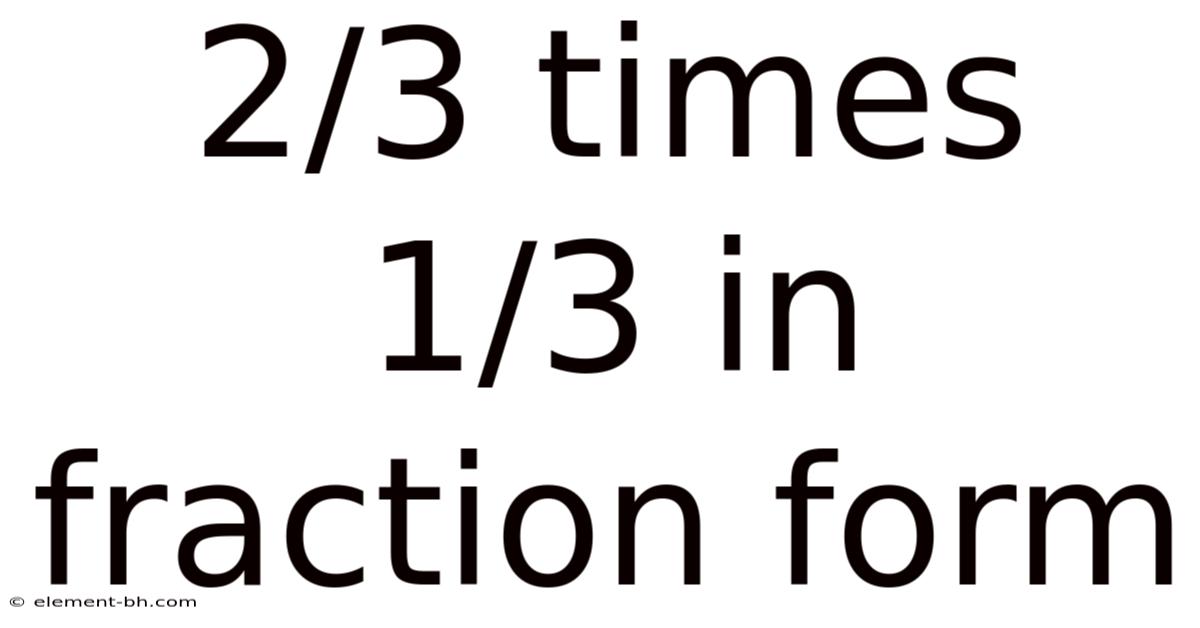
When students first encounter the expression 2/3 times 1/3 in fraction form, they often wonder whether the result will be larger or smaller than the numbers they started with. Unlike whole-number multiplication, where the product typically grows, multiplying two proper fractions produces a value that shrinks. Practically speaking, the expression 2/3 times 1/3 in fraction form equals 2/9, a result that surprises many learners at first glance. Understanding how to arrive at this answer—and why it makes mathematical sense—is an essential building block for anyone studying arithmetic, algebra, or real-world problem solving. In this guide, we will break down the process step by step, explore the logic behind fraction multiplication, and show how this simple calculation appears in everyday situations Small thing, real impact..
Understanding Fraction Multiplication: What Does 2/3 Times 1/3 Mean?
Before jumping into the calculation, it helps to understand what fraction multiplication actually represents. When you see 2/3 times 1/3, you can read it as “two-thirds of one
…two-thirds of one-third. Think of it as taking a part of a part. If you have one-third of a chocolate bar and you eat
