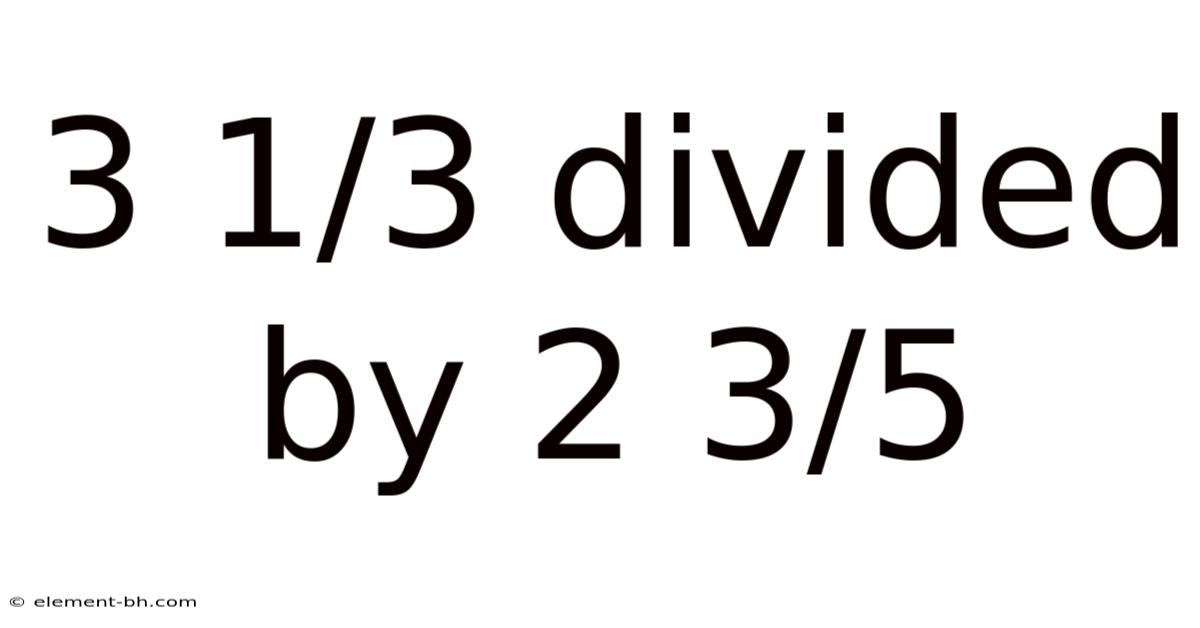
Dividing mixed numbers like 3 1/3 divided by 2 3/5 may seem daunting, but with the right steps it becomes straightforward. This guide explains how to calculate 3 1/3 divided by 2 3/5, breaking down each step for clear understanding and showing why the process works.
Understanding Mixed Numbers
What are mixed numbers?
A mixed number combines a whole number and a proper fraction (e.g., 3 1/3 means three whole units plus one‑third of a unit). They are useful for representing quantities that are not whole numbers but also not pure fractions.
Converting mixed numbers to improper fractions
To divide mixed numbers, it is easiest to rewrite them as improper fractions:
- Multiply the whole number by the denominator.
- Add the numerator.
- Place the result over the original denominator.
For 3 1/3:
- Whole = 3, denominator = 3, numerator = 1
- (3 × 3) + 1 = 10 → 10/3
For 2 3/5:
- Whole = 2, denominator = 5, numerator = 3
- (2 × 5) + 3 = 13 → 13/5
Now the problem becomes 10/3 ÷ 13/5 Worth keeping that in mind. That alone is useful..
Step‑by‑Step Guide to Divide Mixed Numbers
-
Convert both mixed numbers to improper fractions (as shown above) Easy to understand, harder to ignore..
-
Flip the divisor (the second fraction) to create its reciprocal. The reciprocal of 13/5 is 5/13.
-
Multiply the first fraction by the reciprocal:
[ \frac{10}{3} \times \frac{5}{13} = \frac{10 \times 5}{3 \times 13} = \frac{50}{39} ]
-
Simplify if possible. In this case, 50 and 39 share no common factors besides 1, so the fraction is already in lowest terms.
-
Convert back to a mixed number (optional but often preferred):
- 39 goes into 50 one time (1 × 39 = 39) with a remainder of 11.
- So, 50/39 = 1 11/39.
The final answer to 3 1/3 divided by 2 3/5 is 1 11/39.
Mathematical Explanation
Why convert to improper fractions?
Division of fractions relies on the rule that dividing by a fraction equals multiplying by its reciprocal. Working with improper fractions eliminates the extra step of handling whole numbers separately and keeps the arithmetic consistent.
The rule for division of fractions
For any two fractions a/b and c/d:
[ \frac{a}{b} \div \frac{c}{d} = \frac{a}{b} \times \frac{d}{c} ]
Applying this rule to our example:
[ \frac{10}{3} \div \frac{13}{5} = \frac{10}{3} \times \frac{5}{13} ]
The multiplication of numerators (10 × 5) and denominators (3 × 13) yields the result 50/39.
Common Mistakes and How to Avoid Them
- Forgetting to invert the divisor: A frequent error is to multiply by the original second fraction instead of its reciprocal. Always remember to flip the divisor before multiplying.
- Mis‑converting mixed numbers: Double‑check the multiplication and addition steps when turning a mixed number into an improper fraction. A quick sanity check: the improper fraction should be larger than the whole number part.
- Skipping simplification: Even if the fraction appears reduced, verify that the numerator and denominator have no common divisor greater than 1. Simplifying makes the final mixed number easier to interpret.
Real‑Life Applications
Dividing mixed numbers appears in everyday scenarios such as:
- Cooking: Adjusting a recipe that calls for 3 1/3 cups of flour when you only have 2 3/5 of a cup measuring tool.
- Construction: Determining how many 2 3/5‑foot boards are needed to cover a length of 3 1/3 feet.
- Finance: Splitting a fractional interest among partners where each partner’s share is expressed as a mixed number.
Understanding the process helps ensure accurate measurements, budgeting, and resource allocation The details matter here..
FAQ
Q1: Can I divide mixed numbers without converting to improper fractions?
A: Technically you could, but it would involve more complex algebraic manipulation. Converting simplifies the process and reduces error risk.
Q2: What if the division results in a whole number?
A: The resulting improper fraction may simplify to a denominator of 1, which translates directly to a whole number (e.g., 8/2 = 4).
Q3: How do I handle negative mixed numbers?
A: Apply the same conversion steps, keep the sign with the numerator, and follow the division rule; the sign of the result depends on whether the signs of the two fractions are the same or different Not complicated — just consistent..
Q4: Is there a shortcut for simple fractions?
A: For fractions with the same denominator, you can subtract the numerators directly, but for division the reciprocal method remains the most reliable No workaround needed..
Conclusion
Calculating 3 1/3 divided by 2 3/5 becomes manageable once you follow the systematic steps: convert to improper fractions, multiply by the reciprocal, simplify, and optionally revert to a mixed number. This leads to this approach not only yields the correct answer 1 11/39 but also builds a solid foundation for handling any division involving mixed numbers. By mastering these techniques, you’ll be equipped to tackle real‑world problems in cooking, construction, finance, and beyond with confidence and precision Turns out it matters..
