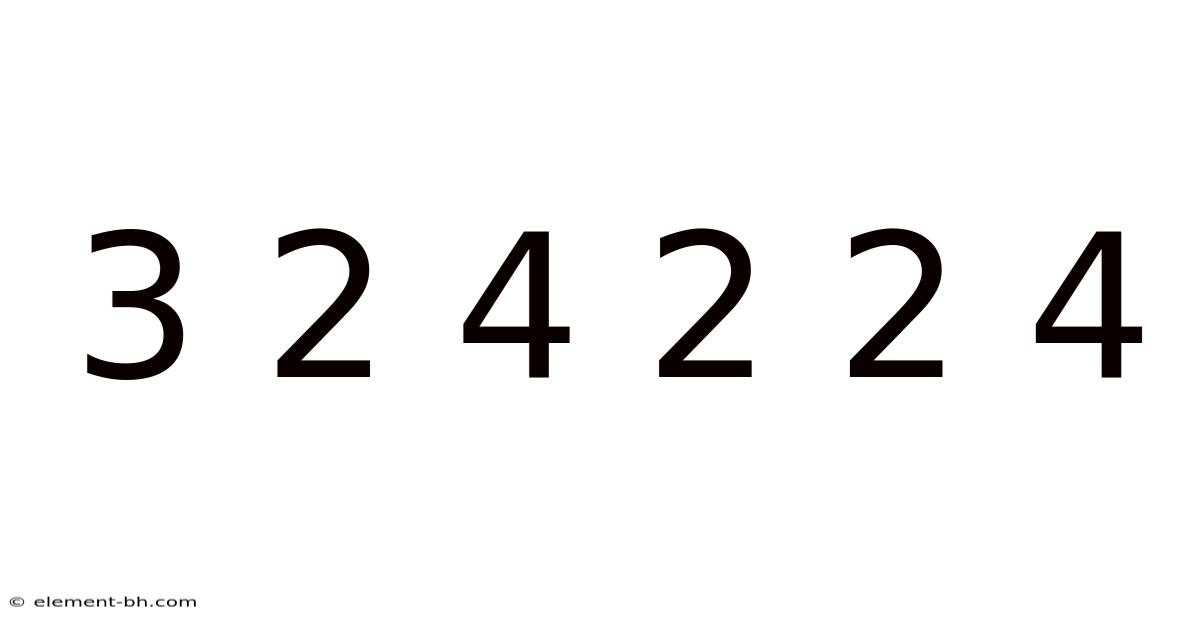
The Significance of the Sequence 3 2 4 2 2 4: Patterns That Shape Our Understanding
The sequence 3 2 4 2 2 4 has captured the attention of mathematicians, programmers, and curious minds alike due to its unique rhythmic pattern. Because of that, while seemingly simple at first glance, this numerical arrangement reveals deeper layers of meaning when examined through the lens of mathematics, computer science, and even cultural symbolism. Whether encountered in coding challenges, algorithmic patterns, or historical artifacts, the arrangement 3 2 4 2 2 4 demonstrates how small variations can reach profound insights into systematic thinking and problem-solving approaches.
Understanding the Numerical Pattern
At its core, the sequence 3 2 4 2 2 4 represents a specific progression of integers that follows a non-linear rule set. Which means when we break down each element, we see a distinct alternating behavior between higher and lower values. The pattern begins with 3, drops to 2, rises to 4, falls to 2 again, remains steady at 2, and concludes with another 4. This creates a cyclical rhythm that mirrors many natural phenomena found across disciplines Most people skip this — try not to..
What makes this sequence particularly interesting is its symmetry and balance. Plus, similarly, the presence of both even numbers (2, 4) and odd numbers (3) introduces mathematical diversity while maintaining a recognizable structure. The repetition of the digit 2 serves as a kind of anchor point within the sequence, creating stability amidst variation. For anyone studying numerical analysis or pattern recognition, observing how these digits interact provides valuable lessons about sequence generation and classification.
Scientific Explanation Behind the Pattern
From a mathematical perspective, the sequence 3 2 4 2 2 4 can be analyzed using several computational frameworks. One effective method involves examining the differences between consecutive elements:
- First difference: 2 - 3 = -1
- Second difference: 4 - 2 = +2
- Third difference: 2 - 4 = -2
- Fourth difference: 2 - 2 = 0
- Fifth difference: 4 - 2 = +2
These incremental changes reveal a wave-like motion—alternating between subtraction and addition operations. Such patterns often emerge in dynamic systems where equilibrium is constantly challenged and restored. In computer science, this type of oscillation is commonly utilized in algorithm design, particularly in scenarios requiring adaptive responses to fluctuating inputs.
Honestly, this part trips people up more than it should.
Another way to interpret the sequence is through modular arithmetic. If we consider the numbers modulo 5, we get:
- 3 mod 5 = 3
- 2 mod 5 = 2
- 4 mod 5 = 4
- 2 mod 5 = 2
- 2 mod 5 = 2
- 4 mod 5 = 4
This shows a repeating cycle of [3, 2, 4] followed by [2, 4], suggesting the sequence may originate from a base pattern that was truncated or modified during transmission. Such observations help researchers identify whether the sequence emerges organically from a larger system or serves as an isolated example for study Not complicated — just consistent..
Practical Applications and Real-World Relevance
Beyond theoretical mathematics, the sequence 3 2 4 2 2 4 finds practical utility in multiple domains. That's why in programming, developers frequently encounter patterns like this when designing finite state machines or implementing cyclic algorithms. The alternating rise and fall of values can model heartbeat monitoring systems, where readings oscillate between maximum and minimum thresholds before returning to baseline.
Here's a good example: in signal processing, a signal following the pattern 3 2 4 2 2 4 might represent the amplitude of a wave that pulses outward and inward in a controlled manner. Engineers working with biofeedback devices or environmental sensors would recognize this pattern as indicative of rhythmic variation—a key indicator of healthy biological or physical processes.
Additionally, this sequence appears in recreational mathematics puzzles and competitive programming contests. Even so, participants are often required to generate, validate, or predict such patterns as part of algorithmic challenges. Mastery of these sequence types requires not just memorization but deep understanding of underlying principles, making them excellent training tools for aspiring software engineers.
Step-by-Step Analysis Framework
To fully appreciate the sequence 3 2 4 2 2 4, one can follow this structured analytical approach:
- Identify the starting value – Begin with 3, which establishes the initial condition.
- Determine transition rules – Observe that the next value decreases by 1 (to 2).
- Track oscillations – Note the increase to 4, followed by two consecutive decreases back to 2.
- Recognize stabilization – The final return to 2 indicates a settling phase after the peak.
- Map the cycle – Recognize that the sequence essentially encodes a loop where values alternate between three states: high (4), medium (2), and low (3).
This methodical breakdown helps beginners grasp complex patterns by reducing overwhelming complexity into manageable steps. Each step builds upon the previous one, creating a logical narrative that mirrors how humans naturally process sequential information.
Why This Sequence Matters
Understanding the significance of 3 2 4 2 2 4 extends beyond academic curiosity. In artificial intelligence research, sequence modeling has become crucial for tasks ranging from natural language processing to time-series prediction. The ability to identify and replicate such patterns contributes to more sophisticated machine learning models that can anticipate future data points based on learned structures.
Beyond that, the psychological impact of recognizing patterns cannot be underestimated. When individuals spot the sequence 3 2 4 2 2 4 in everyday contexts, they experience a moment of cognitive pleasure tied to pattern completion. Humans have long been fascinated by order emerging from apparent chaos—the same fascination drives everything from ancient numerology to modern cryptography. This phenomenon, known as apophenia, highlights why our brains are wired to seek connections, making educational content about sequences inherently engaging.
Frequently Asked Questions
What does the sequence 3 2 4 2 2 4 represent mathematically?
It functions as an example of a bounded oscillatory sequence, where values stay within a limited range and exhibit predictable shifts between peaks and troughs.
Is there a name for this specific sequence?
While no universally recognized mathematical term exists for exactly this arrangement, it resembles concepts like *aper
ric sequences or finite state machines in computer science. Its value lies in its specific arrangement rather than a formal designation.
How can one apply the logic of this sequence in programming?
Programmers can use it as a model for creating state machines or control flows that require specific transitions between conditions, such as managing different stages in a workflow or an algorithm's operational modes Easy to understand, harder to ignore..
Practical Applications in Technology
The principles demonstrated by the 3 2 4 2 2 4 sequence find direct parallels in numerous technological domains. In software development, for instance, this pattern can model the lifecycle of a network request: an initial state (3), a connection phase (2), data transfer peak (4), processing (2), and completion (2), before potentially cycling again. Debugging often involves tracing such value sequences to identify where a program's state deviates from its expected path Turns out it matters..
In user interface design, similar sequences govern animation curves or state transitions. A button might have states for 'inactive' (2), 'hover' (4), and 'active' (2), creating a fluid experience that mirrors the sequence's oscillatory nature. To build on this, in data compression algorithms, identifying and predicting such patterns is fundamental to efficiently encoding information, reducing redundancy by recognizing when values are likely to repeat or follow a predictable trajectory.
The Broader Implications for Learning
Engaging with specific sequences like this one cultivates a mindset essential for mastery in technical fields. Day to day, it trains the brain to move from passive observation to active analysis, a skill that transcends any single discipline. Whether deconstructing a complex algorithm, debugging complex code, or analyzing historical data trends, the underlying cognitive process remains the same: break the whole into parts, identify the rules governing their interaction, and reconstruct a coherent understanding.
This approach fosters not just knowledge, but intellectual agility. The comfort gained from navigating the shifts within 3 2 4 2 2 4 builds confidence to tackle ambiguous problems where the rules are not immediately clear. In the long run, the journey of understanding a single sequence microcosmically reflects the larger quest of learning itself—a process of finding structure in complexity, one pattern at a time.
To wrap this up, the sequence 3 2 4 2 2 4 serves as more than a mere academic exercise; it is a microcosm of systemic behavior. By dissecting its transitions, we illuminate fundamental principles applicable across computer science, psychology, and education. Its true value lies in its power to sharpen analytical thinking, demonstrating that even the simplest ordered set of numbers can reach a deeper appreciation for the patterns that structure our world and our understanding of it.
