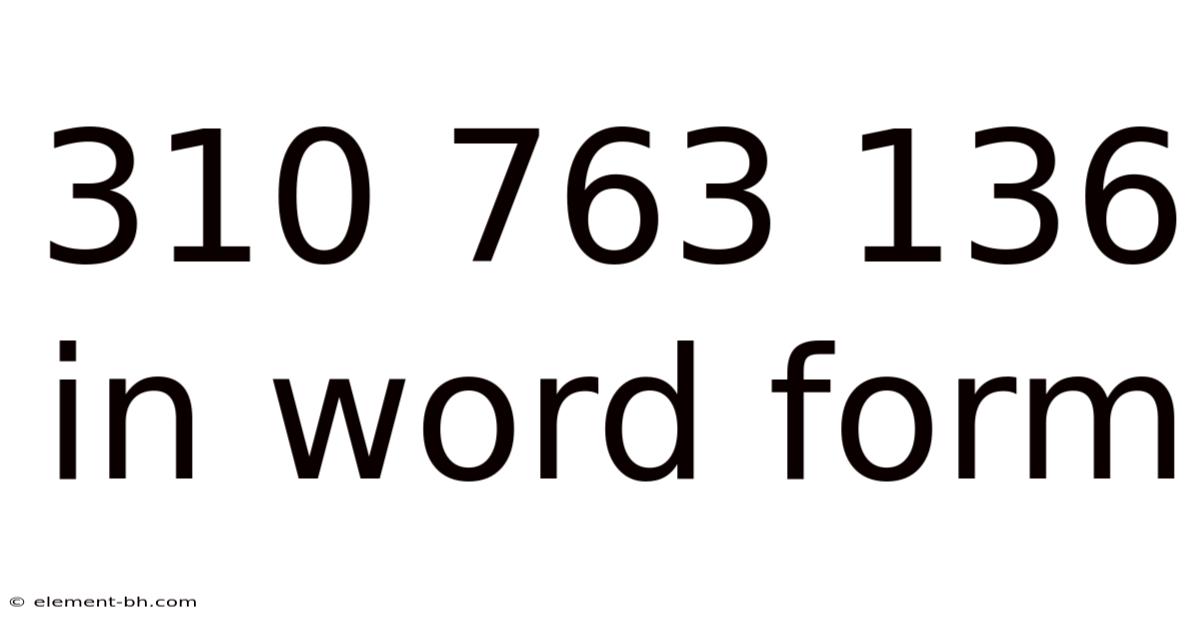
When faced with the task of expressing the numeral 310 763 136 in word form, many learners pause to consider how each group of digits translates into English language terms. This seemingly simple conversion actually reinforces a deeper understanding of place value, number naming conventions, and the logical structure that underlies our base‑10 system. In the sections that follow, we will break down the process step by step, explore why the conversion works the way it does, highlight common pitfalls, and show practical situations where writing numbers in words is not just an academic exercise but a useful skill.
Understanding Place Value Foundations
Before diving into the actual wording, it helps to revisit the concept of place value. Each digit in a whole number occupies a position that determines its contribution to the overall magnitude. In the number 310,763,136, the positions from left to right are:
- Hundred‑millions (3)
- Ten‑millions (1)
- Millions (0)
- Hundred‑thousands (7)
- Ten‑thousands (6)
- Thousands (3)
- Hundreds (1)
- Tens (3)
- Ones (6)
Grouping these digits into sets of three—starting from the right—creates the familiar “thousands,” “millions,” and “billions” periods. For 310,763,136 we have three groups:
- 310 (the millions period)
- 763 (the thousands period)
- 136 (the units period)
Recognizing these groups is the first mental shortcut that makes converting large numbers to words far less intimidating No workaround needed..
Step‑by‑Step Conversion Process
Below is a clear, numbered procedure you can follow whenever you need to write any integer in word form. Apply it to 310,763,136, and you will see how each step builds on the previous one Turns out it matters..
-
Separate the number into three‑digit periods
Write the number with spaces or commas every three digits from the right: 310 763 136 → [310] [763] [136]. -
Name each period (except the units)
- The leftmost group (310) belongs to the millions period.
- The middle group (763) belongs to the thousands period.
- The rightmost group (136) is the units (or “ones”) period and does not receive a period name.
-
Convert each three‑digit group into words
- 310 → three hundred ten
- 763 → seven hundred sixty‑three
- 136 → one hundred thirty‑six
Note that when a group is exactly 000, you would skip it entirely (e.g., 5,000,000 becomes “five million” without mentioning the thousands or units groups) Which is the point..
-
Attach the appropriate period name to each non‑units group
- 310 million → three hundred ten million
- 763 thousand → seven hundred sixty‑three thousand
- 136 → one hundred thirty‑six
-
Combine the worded groups with commas (or spaces) and the word “and” only if required by style
In American English, the word “and” is reserved for decimal points, so we simply list the groups:
three hundred ten million, seven hundred sixty‑three thousand, one hundred thirty‑six. -
Check for consistency and readability
Verify that each group is correctly spelled, hyphenated where needed (sixty‑three, thirty‑six), and that no extra words have been inserted.
Applying these steps to 310 763 136 in word form yields the final result:
three hundred ten million, seven hundred sixty‑three thousand, one hundred thirty‑six Still holds up..
Scientific Explanation Behind the Naming Convention
The English system for naming large numbers is rooted in the short scale, which is used in the United States, modern Britain, and most English‑speaking countries. In the short scale, each new term greater than a million is 1,000 times the previous term:
- Million = 10⁶
- Billion = 10⁹
- Trillion = 10¹²
Because our number falls below one billion, we only need the “million” and “thousand” labels. The logic mirrors how we group digits: each group of three represents a power of 1,000 (10³ⁿ). The leftmost group indicates how many millions, the next group indicates how many thousands, and the final group counts the remaining ones.
And yeah — that's actually more nuanced than it sounds.
If we were using the long scale (still common in many European countries), a “billion” would mean 10¹², and the naming would differ for numbers above 10⁹. Still, for 310,763,136 the short‑scale and long‑scale representations coincide because the number does not reach the threshold where the two systems diverge And that's really what it comes down to. Surprisingly effective..
Common Mistakes and How to Avoid Them
Even with a clear procedure, learners often slip into predictable errors. Below is a list of frequent mistakes paired with tips to prevent them.
- Misplacing the period name
...is one of the most frequent errors when writing large numbers. Forgetting to attach "million" or "thousand" to the correct group can completely change the value—saying "three
hundred ten million, seventy-six thousand three hundred" instead of "three hundred ten million, seven hundred sixty-three thousand, one hundred thirty-six.And " To avoid this, always verify that each group of three digits is paired with its corresponding period name (million, thousand, etc. ) and that the numerical value of each group is accurately converted It's one of those things that adds up..
-
Overhyphenating or underhyphenating compound numbers
Hyphens are only needed for compound numbers from twenty-one to ninety-nine when they are not multiples of ten (e.g., sixty-three, thirty-six). Forgetting hyphens or adding them unnecessarily can lead to confusion (e.g., "twenty one" vs. "twenty-one"). Always hyphenate compound numbers in the tens and ones places but leave standalone tens like seventy or eighty unhyphenated. -
Misusing the word "and"
In American English, "and" is typically reserved for decimal points (e.g., three dollars and fifty cents). Using it in the middle of a number, such as "three hundred and ten million," is incorrect in U.S. style. Stick to commas to separate the groups. -
Skipping zeros in the middle of a number
If a group of zeros appears between non-zero digits (e.g., 300,004,001), it must still be explicitly stated. Take this: 300,004,001 becomes three hundred million, four thousand, one. Omitting the "four thousand" would incorrectly imply 300,000,001. -
Reversing the order of groups
The leftmost group always represents the largest period name (e.g., millions, billions). Writing "thousand three hundred ten million" instead of "three hundred ten million, seven hundred sixty-three thousand" inverts the magnitude and creates a nonsensical value.
Final Check: Why This Matters
Mastering the conversion of large numbers into words is more than a classroom exercise—it sharpens numerical literacy and reduces ambiguity in fields like finance, science, and international communication. By breaking down the process into clear steps and avoiding common pitfalls, you ensure precision when discussing sums of money, population statistics, or astronomical distances.
To keep it short, translating 310,763,136 into words requires attention to grouping, period names, and punctuation. With practice, this method becomes second nature, allowing you to articulate even the largest numbers with confidence and clarity Easy to understand, harder to ignore..
three hundred ten million, seven hundred sixty-three thousand, one hundred thirty-six
This structured approach not only yields accurate results but also deepens your understanding of how our numerical system organizes scale. Whether you’re drafting a legal document, analyzing data, or simply sharing a budget, these principles ensure your words match your numbers.
