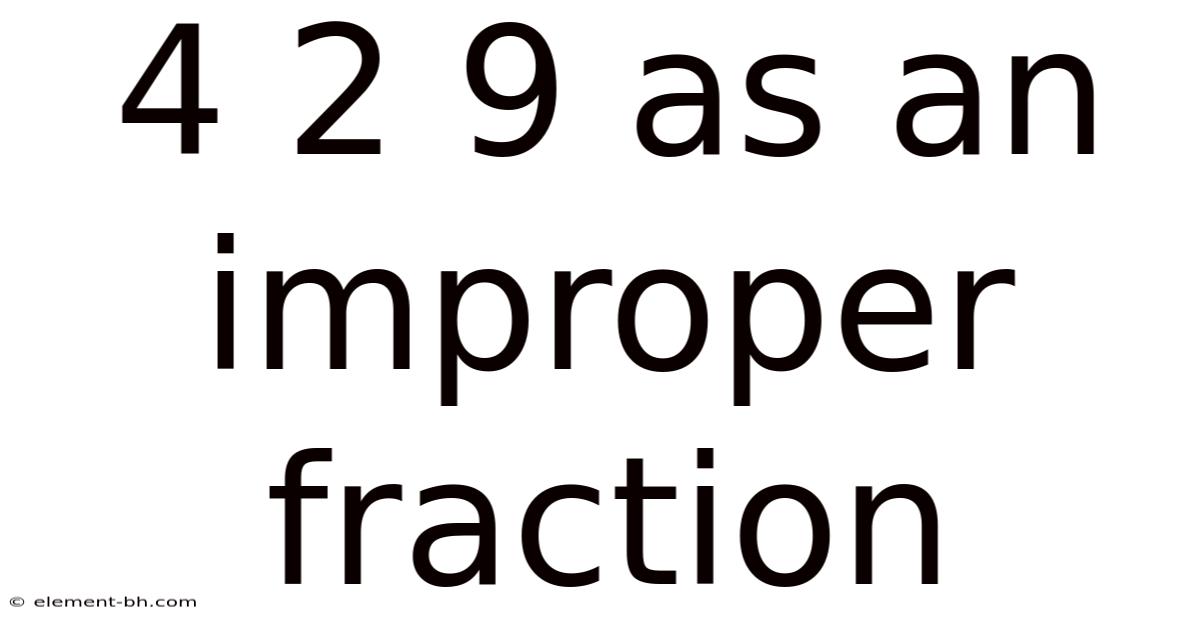
4 2 9 as an improper fraction is a common conversion task that appears in elementary arithmetic, algebra, and everyday problem‑solving. Understanding how to turn a mixed number like (4\frac{2}{9}) into an improper fraction builds a foundation for operations such as addition, subtraction, multiplication, and division of fractions. This article walks through the concept, the conversion process, the reasoning behind it, and practical ways to apply the skill Small thing, real impact. No workaround needed..
Introduction: What Does “4 2 9 as an improper fraction” Mean?
When we see the notation (4\frac{2}{9}), we are looking at a mixed number—a whole number (4) combined with a proper fraction ((\frac{2}{9})). , (\frac{38}{9})). Plus, converting (4\frac{2}{9}) to an improper fraction means expressing the same quantity solely as a fraction whose top number (numerator) exceeds its bottom number (denominator). Because of that, an improper fraction is a fraction where the numerator is greater than or equal to the denominator (e. g.The result is (\frac{38}{9}).
Understanding Mixed Numbers and Improper Fractions
Before diving into the conversion, it helps to clarify the two forms:
| Form | Definition | Example |
|---|---|---|
| Mixed number | Whole number + proper fraction (numerator < denominator) | (3\frac{5}{8}) |
| Improper fraction | Fraction where numerator ≥ denominator | (\frac{29}{8}) |
Both representations denote the same value. The mixed number emphasizes the “whole” part, while the improper fraction is often more convenient for calculations because it keeps everything in a single fraction Easy to understand, harder to ignore..
Step‑by‑Step Conversion of (4\frac{2}{9})
Converting a mixed number to an improper fraction follows a simple algorithm:
- Multiply the whole number by the denominator of the fractional part.
- Add the numerator of the fractional part to the product from step 1.
- Place the sum over the original denominator.
Applying these steps to (4\frac{2}{9}):
- Multiply: (4 \times 9 = 36).
- Add the numerator: (36 + 2 = 38).
- Write over the denominator: (\frac{38}{9}).
Thus, (4\frac{2}{9} = \frac{38}{9}).
Visual Illustration
Imagine you have four whole pies, each cut into nine equal slices. That gives you (4 \times 9 = 36) slices. Day to day, the fractional part (\frac{2}{9}) adds two more slices from another pie. In total you have (36 + 2 = 38) slices, each representing one‑ninth of a pie. Hence the improper fraction (\frac{38}{9}) Practical, not theoretical..
Why the Conversion Works: Mathematical Reasoning
The algorithm is rooted in the distributive property of multiplication over addition:
[ 4\frac{2}{9} = 4 + \frac{2}{9} = \frac{4 \times 9}{9} + \frac{2}{9} = \frac{36}{9} + \frac{2}{9} = \frac{36+2}{9} = \frac{38}{9}. ]
By converting the whole number (4) into ninths ((\frac{36}{9})), we create a common denominator with the fractional part, allowing straightforward addition of numerators.
Practical Examples and Applications
Example 1: Adding Mixed Numbers
Suppose you need to add (4\frac{2}{9}) and (3\frac{5}{9}). Converting both to improper fractions simplifies the process:
[ 4\frac{2}{9} = \frac{38}{9},\qquad 3\frac{5}{9} = \frac{32}{9}. ]
Now add:
[ \frac{38}{9} + \frac{32}{9} = \frac{70}{9} = 7\frac{7}{9}. ]
Example 2: Scaling a Recipe
A recipe calls for (4\frac{2}{9}) cups of flour, but you want to make half the batch. Working with an improper fraction makes halving easy:
[ \frac{38}{9} \times \frac{1}{2} = \frac{38}{18} = \frac{19}{9} = 2\frac{1}{9}\text{ cups}. ]
Example 3: Algebraic Expressions
When solving equations that contain mixed numbers, converting them to improper fractions avoids dealing with separate whole‑number and fractional terms:
[ x + 4\frac{2}{9} = 10 ;\Longrightarrow; x + \frac{38}{9} = 10 ;\Longrightarrow; x = 10 - \frac{38}{9} = \frac{90}{9} - \frac{38}{9} = \frac{52}{9} = 5\frac{7}{9}. ]
Common Mistakes to Avoid
| Mistake | Why It’s Wrong | Correct Approach |
|---|---|---|
| Forgetting to multiply the whole number by the denominator | Leads to an incorrect numerator | Always perform ( \text{whole} \times \text{denominator} ) first |
| Adding the denominator instead of the numerator | Changes the value drastically | Add only the numerator after multiplication |
| Using the wrong denominator after conversion | Results in a fraction that is not equivalent | Keep the original denominator unchanged |
| Simplizing prematurely before conversion | May lose track of the whole‑number component | Convert first, then simplify if needed |
Honestly, this part trips people up more than it should No workaround needed..
Practice Problems
Try converting the following mixed numbers to improper fractions. Answers are provided at the end.
- (5\frac{3}{7})
- (2\frac{11}{13})
- (9\frac{4}{5})
- (1\frac{8}{9})
- (7\frac{0}{4}) (note the zero numerator)
Answers
- (\frac{38}{7})
- (\frac{37}{13})
- (\frac{49}{5})
- (\frac{17}{9})
- (\frac{28}{4} = 7) (since the fractional part is zero, the improper fraction reduces to the whole number)
Frequently Asked Questions
Q: Can an improper fraction be turned back into a mixed number?
A: Yes. Divide the numerator by the denominator; the quotient is the whole number, and the remainder over the original denominator is the fractional part. For (\frac{38}{9}), (38 ÷ 9
