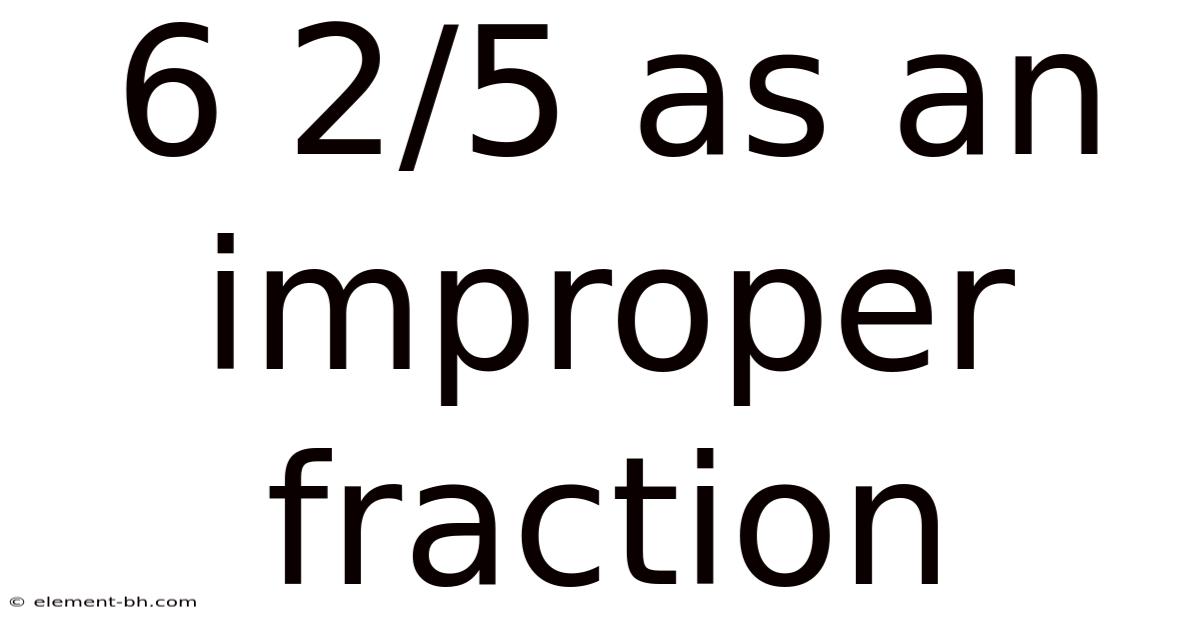
Understanding how to convert mixed numbers into improper fractions is a fundamental skill in arithmetic that serves as a bridge between basic number sense and more advanced algebraic concepts. The specific conversion of 6 2/5 as an improper fraction provides a perfect case study for mastering this process. While the answer itself is a single number, the journey to that answer reinforces critical mathematical reasoning regarding wholes, parts, and the relationship between multiplication and division. This guide will walk you through the conversion step-by-step, explain the underlying theory, offer visual models for deeper comprehension, and explore why this skill matters in real-world scenarios and higher-level mathematics.
What Is a Mixed Number vs. an Improper Fraction?
Before diving into the specific calculation for 6 2/5, Define the two forms we are translating between — this one isn't optional. That's why a mixed number combines a whole number and a proper fraction. It represents a quantity greater than one whole but expressed in a way that highlights the integer count and the remaining fractional part. In the expression $6 \frac{2}{5}$, the 6 represents six complete units, and the $\frac{2}{5}$ represents two parts out of five equal parts of a seventh unit Not complicated — just consistent..
Quick note before moving on.
An improper fraction, conversely, is a fraction where the numerator (the top number) is greater than or equal to the denominator (the bottom number). g.It represents the total number of fractional parts without separating the wholes. Neither form is "more correct" than the other; they are simply different languages for describing the same quantity. In practice, mixed numbers are often preferred for measurement and estimation (e. , "6 and 2/5 cups of flour"), while improper fractions are the standard for calculation, algebra, and calculus because they follow standard fraction arithmetic rules without requiring special handling for the whole number component.
The Standard Conversion Algorithm: Step-by-Step
The most efficient way to convert $6 \frac{2}{5}$ into an improper fraction relies on a simple, three-step algorithm often remembered by the mnemonic "MAD" (Multiply, Add, Denominator). Here is the breakdown applied to our specific problem:
Step 1: Multiply the Whole Number by the Denominator
The denominator (5) tells us how many pieces make up one whole unit. Since we have 6 whole units, we need to find out how many "fifths" exist in those 6 wholes. $6 \times 5 = 30$ There are 30 fifths in 6 wholes.
Step 2: Add the Numerator
We aren't just dealing with 6 wholes; we have an additional fractional part: $\frac{2}{5}$. This means we have 2 extra fifths on top of the 30 we just calculated. $30 + 2 = 32$ This sum (32) becomes the new numerator. It represents the total count of fifths Simple as that..
Step 3: Keep the Denominator the Same
The size of the pieces hasn't changed. We are still counting in "fifths." Because of this, the denominator remains 5.
The Result
Combining the new numerator with the original denominator gives us the improper fraction: $\frac{32}{5}$
Because of this, $6 \frac{2}{5}$ as an improper fraction is $\frac{32}{5}$.
Visualizing the Conversion: Why the Algorithm Works
Rote memorization of "Multiply, Add, Denominator" is useful for speed, but true mathematical fluency comes from understanding why it works. Visual models are powerful tools for this Worth knowing..
The Area Model (Fraction Circles or Bars)
Imagine drawing 6 complete circles, each divided into 5 equal slices (fifths).
- Count the slices in the wholes: 6 circles $\times$ 5 slices = 30 slices.
- Draw one more circle divided into 5 slices. Shade only 2 of them. This represents the $\frac{2}{5}$.
- Count all shaded slices: 30 (from the wholes) + 2 (from the partial) = 32 slices.
- Define the unit: Since every slice is $\frac{1}{5}$, the total is $\frac{32}{5}$.
The Number Line Model
Draw a number line from 0 to 7. Mark every interval of $\frac{1}{5}$ Which is the point..
- The whole numbers 1, 2, 3, 4, 5, 6 correspond to $\frac{5}{5}, \frac{10}{5}, \frac{15}{5}, \frac{20}{5}, \frac{25}{5}, \frac{30}{5}$.
- Starting at 6 ($\frac{30}{5}$), jump two more fifths to the right.
- You land on the tick mark labeled $\frac{32}{5}$.
Both models prove that the multiplication step ($6 \times 5$) is essentially a shortcut for counting the fractional units inside the whole numbers, and the addition step accounts for the "leftovers."
Verifying the Answer: Reverse Engineering
A hallmark of mathematical confidence is the ability to check your work. To verify that $\frac{32}{5}$ equals $6 \frac{2}{5}$, perform the reverse operation: Division with Remainder Turns out it matters..
Divide the numerator (32) by the denominator (5): $32 \div 5 = 6 \text{ with a remainder of } 2$
- The quotient (6) becomes the whole number.
- The remainder (2) becomes the new numerator.
- The divisor (5) stays the denominator.
Result: $6 \frac{2}{5}$. The conversion is verified That alone is useful..
Common Pitfalls and How to Avoid Them
Even with a simple algorithm, errors frequently occur. Being aware of these traps saves points on exams and prevents calculation errors in complex problems.
-
Adding the Whole Number Instead of Multiplying:
- Error: $6 + 2 = 8$, resulting in $\frac{8}{5}$.
- Correction: Remember that the whole number represents groups of the denominator. You must multiply to find the total parts in those groups.
-
Changing the Denominator:
- Error: Multiplying the denominator by the whole number ($5 \times 6 = 30$) and using that as the new denominator ($\frac{32}{30}$).
- Correction: The denominator defines the size of the piece. Cutting a pizza into 5 slices vs 30 slices changes the size of the slice entirely. The denominator never changes during this specific conversion.
-
Confusing Improper Fractions with Simplification:
- Error: Trying to simplify $\frac{32}{5}$ immediately.
- Correction: $\frac{32}{5}$ is already in simplest form because 32 and 5 share no common factors (5 is prime and does not divide 32). Conversion and simplification are distinct steps.
-
Misidentifying the Parts:
- Error: In a mixed number like $6 \frac{2}{5}$, confusing the whole number (6) with the numerator (2).
- Correction: Label the parts explicitly: $W \frac{N}{D}$. Whole=6, Numerator=2, Denominator=5.
Real-World Applications: Where Do We Use This?
Students often ask, "When will I ever use this?" The conversion of mixed numbers to improper fractions is not just academic busywork
