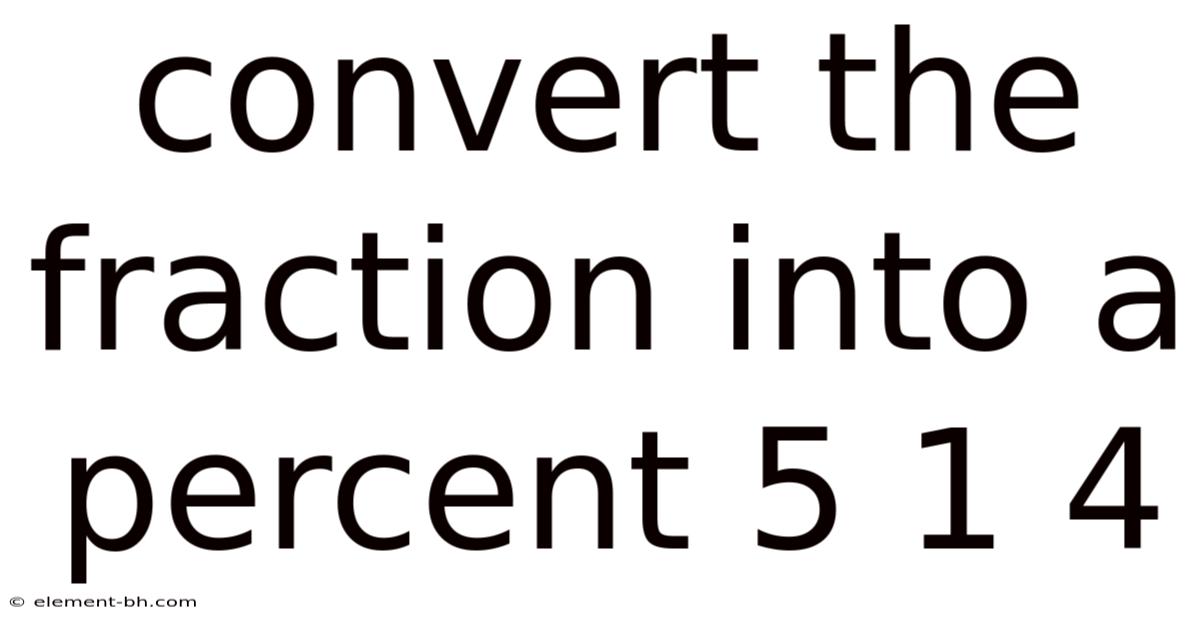
Of course. Here is a comprehensive, SEO-optimized article on converting the fraction 5 1/4 into a percentage.
How to Convert 5 1/4 into a Percentage: A Clear, Step-by-Step Guide
Converting the mixed fraction 5 1/4 into a percentage is a fundamental skill in mathematics that bridges the gap between fractions and percentages, two concepts we encounter daily in contexts like cooking, shopping, and financial literacy. This article provides a detailed, easy-to-follow guide to understanding and performing this conversion. We will explore the underlying concepts, break down the process into simple steps, and provide practical examples to solidify your understanding. By the end, you will not only know the answer—525%—but also the why and how behind it, empowering you to tackle similar conversions with confidence Simple as that..
Understanding the Components: Fractions and Percentages
Before diving into the conversion, it's crucial to understand what we are working with Small thing, real impact..
- What is a Fraction? A fraction represents a part of a whole. The number on top is the numerator (indicating how many parts we have), and the number on the bottom is the denominator (indicating how many equal parts the whole is divided into). In the case of 1/4, it means one part out of four equal parts.
- What is a Mixed Fraction? A mixed fraction, like 5 1/4, combines a whole number (5) with a fraction (1/4). This signifies five whole units plus one-quarter of another unit.
- What is a Percentage? The term "percent" literally means "per hundred." A percentage is a fraction where the denominator is always 100. So, 50% is equivalent to 50/100 or 1/2. Converting any number to a percentage is essentially expressing it as a fraction of 100.
The goal, therefore, is to take the value represented by 5 1/4 and express it as a number out of 100 Worth knowing..
Method 1: The Two-Step Process (Converting to an Improper Fraction First)
This is a reliable and widely taught method. It involves two clear stages: first, converting the mixed fraction to an improper fraction, and then converting that improper fraction to a percentage.
Step 1: Convert the Mixed Fraction to an Improper Fraction
An improper fraction is one where the numerator is equal to or larger than the denominator. This form is often easier to work with for calculations.
The formula to convert a mixed number to an improper fraction is: (Whole Number × Denominator) + Numerator = New Numerator
Let's apply this to 5 1/4:
- Multiply the whole number (5) by the denominator (4): 5 × 4 = 20.
- Add the numerator (1) to this result: 20 + 1 = 21. Worth adding: 3. So naturally, this new number (21) becomes the numerator of our improper fraction. The denominator stays the same (4).
So, 5 1/4 as an improper fraction is 21/4 Simple, but easy to overlook..
Step 2: Convert the Improper Fraction to a Percentage
To convert any fraction to a percentage, you multiply it by 100 and add the percent sign (%).
The calculation is: (Fraction) × 100%
For our fraction, 21/4: (21/4) × 100%
Now, perform the multiplication:
- You can multiply the numerator by 100 first: 21 × 100 = 2100.
- Then, divide by the denominator: 2100 ÷ 4 = 525.
Because of this, (21/4) × 100% = 525% Small thing, real impact..
Result: 5 1/4 is equal to 525%.
Method 2: The Decimal Conversion Method
Another intuitive approach is to convert the mixed fraction into a decimal number first, and then convert that decimal into a percentage. This method is often quicker for those comfortable with decimal operations Worth keeping that in mind..
Step 1: Convert the Mixed Fraction to a Decimal
The fraction part, 1/4, can be easily converted to a decimal by dividing the numerator by the denominator: 1 ÷ 4 = 0.25 Less friction, more output..
Now, simply combine this decimal with the whole number: 5 + 0.25 = 5.25.
So, 5 1/4 as a decimal is 5.25.
Step 2: Convert the Decimal to a Percentage
Converting a decimal to a percentage is straightforward: you multiply the decimal by 100 and add the percent sign. Effectively, this means moving the decimal point two places to the right Turns out it matters..
For 5.25: 5.25 × 100% = 525%.
Result: Again, we find that 5 1/4 is equal to 525% It's one of those things that adds up..
A Practical, Real-World Example
Let's see how this conversion applies in a real-life scenario. Imagine you are comparing two discounts on a piece of furniture.
- Store A offers a discount of "5 1/4% off" the original price.
- Store B advertises a "5.25% off" discount.
At first glance, these might seem like different discounts. Still, as you've just learned, 5 1/4% and 5.25% are two different ways of expressing the same value. The mixed fraction and the decimal are equivalent. This example highlights the importance of being able to convert between these forms to make accurate comparisons in financial situations, such as sales, interest rates, and taxes Small thing, real impact. Simple as that..
Key Takeaways and Recap
To summarize the conversion of 5 1/4 to a percentage:
- Understand the Goal: Percent means "per hundred." You are finding what part of 100 the fraction represents.
- Choose Your Method:
- Improper Fraction Method: Convert 5 1/4 to 21/4, then calculate (21/4) × 100% = 525%.
- Decimal Method: Convert 5 1/4 to 5.25, then calculate 5.25 × 100% = 525%.
- The Answer: Both methods consistently show that 5 1/4 = 525%.
This conversion is more than just a classroom exercise; it's a practical tool for interpreting data, understanding statistics, and making informed decisions in everyday life. Mastering this process builds a stronger foundation in mathematics and enhances your numerical literacy Turns out it matters..
Frequently Asked Questions (FAQ)
Q: Why is 5 1/4 equal to 525% and not 5.25%? A: This is a common point of confusion. The value of 5 1/4 is 5.25. When you convert this value to a percentage, you are expressing it as a fraction of 1. So, 5.25 as a decimal is 525% because 5.25 = 525/100. A value greater than 1 (or 10
0%). Since 5 1/4 (or 5.25) is greater than 1, the resulting percentage must be greater than 100%. The confusion often arises from mixing up the decimal representation (5.25) with the percentage representation (525%). Remember: to go from decimal to percent, you multiply by 100.
Q: Can I convert a mixed fraction to a percentage without turning it into an improper fraction first? A: Yes. You can convert the fractional part to a percentage separately and add it to the whole number's percentage equivalent.
- Whole number: 5 = 500%
- Fraction: 1/4 = 25%
- Total: 500% + 25% = 525% This "distributive method" is often faster for mental math when the fractional part is a common fraction (like 1/2, 1/4, 3/4, 1/5).
Q: When would I ever encounter a percentage over 100% in real life? A: Percentages over 100% are standard in contexts involving growth, comparison, or markup.
- Sales Markup: If a store buys an item for $20 and sells it for $105, the selling price is 525% of the cost price.
- Population Growth: If a town grows from 1,000 residents to 5,250, the new population is 525% of the original.
- Efficiency/Output: A machine producing 525 units per hour against a baseline target of 100 units is operating at 525% efficiency.
Q: Is there a shortcut for converting mixed fractions with denominators of 4, 5, or 10? A: Absolutely. Because these denominators divide evenly into 100, you can scale the fraction directly to a denominator of 100 The details matter here..
- For 1/4: Multiply numerator and denominator by 25 → 25/100 = 25%.
- For 3/5: Multiply by 20 → 60/100 = 60%.
- For 7/10: Multiply by 10 → 70/100 = 70%. Then simply add the whole number's percentage (e.g., 5 = 500%) to the fractional percentage.
Conclusion
Converting a mixed fraction like 5 1/4 into a percentage is a fundamental skill that bridges the gap between abstract arithmetic and practical application. Whether you prefer the structural rigor of the improper fraction method, the speed of the decimal conversion, or the intuitive logic of the distributive method, the result remains a consistent 525% Took long enough..
Most guides skip this. Don't.
The ability to fluidly move between fractions, decimals, and percentages empowers you to interpret financial reports, analyze statistical data, calculate discounts, and understand growth metrics with confidence. Still, mathematics is rarely about memorizing a single rigid procedure; it is about possessing a toolkit of strategies and selecting the right tool for the job at hand. By mastering these conversions, you add a versatile and essential instrument to that toolkit, ensuring that the next time you encounter a mixed fraction in a contract, a news article, or a recipe, you can instantly grasp its true magnitude.
