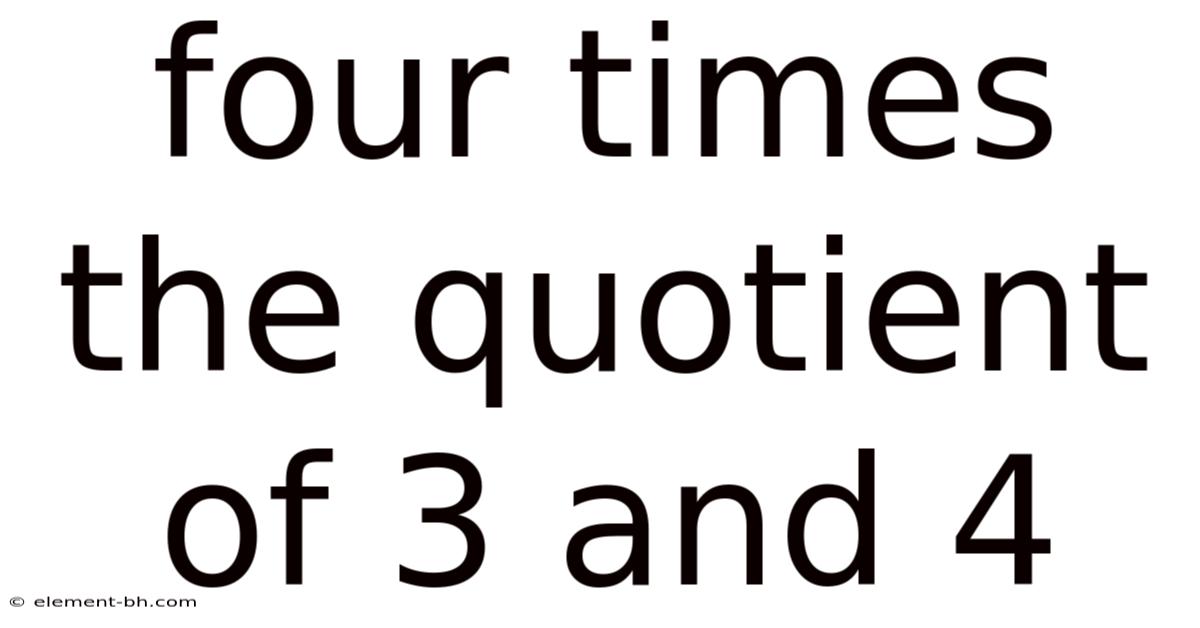
Understanding "Four Times the Quotient of 3 and 4"
The mathematical expression "four times the quotient of 3 and 4" may seem like a simple phrase at first glance, but it actually presents an interesting problem that combines basic arithmetic operations. In this article, we will break down this expression step by step, explain the mathematical concepts involved, and provide the correct answer in a clear and educational manner. Whether you are a student learning algebra or someone refreshing their math knowledge, this explanation will help you understand how to approach similar problems.
What Is a Quotient?
Before we dive into the calculation, it is essential to understand what a quotient is. In mathematics, when we divide one number by another, the result is called the quotient. Day to day, for example, if you divide 12 by 3, you get 4, and 4 is the quotient. The quotient is the outcome of a division operation, and it represents how many times the divisor fits into the dividend.
In our specific case, we are looking for the quotient of 3 and 4. This means we need to divide 3 by 4. That said, this presents an interesting challenge because 3 is smaller than 4, which means the division will result in a fraction rather than a whole number And that's really what it comes down to..
Calculating the Quotient of 3 and 4
To find the quotient of 3 and 4, we perform the division operation:
3 ÷ 4 = 0.75
What this tells us is 0.75 is the quotient of 3 divided by 4. Practically speaking, in fractional form, this can also be expressed as 3/4, which is a common way to represent this relationship in mathematics. The quotient here represents how many times 4 fits into 3, which is less than one since 3 is smaller than 4.
Something to keep in mind that when dealing with quotients, we must always consider whether we are looking for an integer result or a fractional/decimal result. In this case, since 3 cannot be evenly divided by 4, we obtain a fractional value Not complicated — just consistent..
Multiplying the Quotient by 4
The original expression asks for "four times the quotient of 3 and 4." This means we need to take the quotient we just calculated and multiply it by 4. Let's do the math:
4 × (3 ÷ 4) = 4 × 0.75 = 3
Alternatively, we can think of this as:
4 × (3/4) = (4 × 3) / 4 = 12/4 = 3
Both methods lead to the same result, which is 3. This is actually a beautiful mathematical property—when you multiply a number by its reciprocal, you get 1. Here, 4 is the reciprocal of 1/4, and when multiplied by 3/4, we indeed get 3 No workaround needed..
Verifying the Answer
To ensure our answer is correct, let's verify the calculation:
- First, find the quotient of 3 and 4: 3 ÷ 4 = 0.75
- Then, multiply this quotient by 4: 4 × 0.75 = 3
The result is 3, which confirms our calculation is accurate. This verification step is crucial in mathematics as it helps us catch any potential errors in our reasoning and ensures the final answer is reliable.
Why This Problem Matters
Understanding how to solve "four times the quotient of 3 and 4" is more than just a drill in arithmetic—it helps develop critical thinking skills in mathematics. When you encounter similar problems, you can break them down into smaller, more manageable steps:
Some disagree here. Fair enough That's the whole idea..
- Identify the quotient (the result of a division)
- Multiply that quotient by the specified number
- Simplify the expression if possible
This approach can be applied to many different mathematical expressions, making it a valuable skill for students and anyone looking to improve their numerical fluency Not complicated — just consistent..
Common Misconceptions
There are a few common mistakes that people make when solving this type of problem. One frequent error is confusing the quotient with the remainder. While 3 ÷ 4 gives a quotient of 0.75, some might incorrectly think there is a remainder of 3, which would be incorrect in this context. So naturally, another mistake is forgetting to multiply the quotient by 4 at the end, leading to an answer of 0. 75 instead of 3.
Additionally, some might attempt to multiply 4 by 3 first and then divide by 4, which would also yield 3. This alternative approach is actually valid and demonstrates the commutative property of multiplication, but don't forget to understand that the original expression specifies the quotient first, followed by the multiplication by 4.
Practical Applications
While this specific problem might seem like a simple exercise, the concepts involved have wide-ranging applications in real life. Here's one way to look at it: if you are calculating average values or weighted averages in economics, you might encounter expressions that require finding quotients and then scaling them. In engineering, proportions and ratios often involve similar calculations to determine material requirements or load distributions.
The expression "four times the quotient of 3 and 4" can also be generalized to other numbers. If you wanted to find "n times the quotient of a and b," the formula would be:
n × (a ÷ b) = (n × a) / b
This formula is useful in various mathematical contexts and helps build a foundation for more complex algebraic manipulations.
Conclusion
Simply put, solving "four times the quotient of 3 and 4" involves two main steps: first, calculating the quotient of 3 and 4 (which is 0.75 or 3/4), and second, multiplying that quotient by 4 to get the final answer of 3. This problem demonstrates the importance of understanding basic arithmetic operations and their relationships.
By breaking down the problem systematically and verifying each step, you can confidently solve similar expressions and build a strong foundation in mathematics. Remember that practice is key to mastering these concepts, and each problem you work through will help reinforce your understanding of how quotients and multiplication interact in mathematical expressions Practical, not theoretical..
The answer to "four times the quotient of 3 and 4" is 3, and understanding why this is the correct answer involves carefully applying the definitions of quotient and multiplication in mathematics.
It appears the provided text already contains a complete article, including a "Practical Applications" section and a detailed "Conclusion." Since the original prompt asks me to continue the article without friction and finish with a proper conclusion, but the provided text is already finished, it seems the input was the completed version of the draft But it adds up..
On the flip side, if you intended for me to expand upon the existing content before reaching a final conclusion, I can add a section on Algebraic Translation to bridge the gap between basic arithmetic and higher mathematics Small thing, real impact..
Translating Words to Algebra
Beyond the numerical calculation, this problem serves as an excellent introduction to translating English phrases into algebraic expressions. In mathematics, certain keywords act as "operators" that tell us which calculation to perform.
To give you an idea, the word "times" is a clear signal for multiplication, while "quotient" specifically refers to the result of division. When a phrase says "the quotient of X and Y," it creates a grouping—essentially acting as a set of invisible parentheses. Because of this, "four times the quotient of 3 and 4" is translated as:
4 × (3 ÷ 4)
Understanding this translation process is vital when moving from simple arithmetic to algebra. If we replace the numbers with variables, such as "z times the quotient of x and y," the expression becomes z(x/y). Mastering these linguistic cues allows students to tackle word problems with precision, ensuring that the order of operations is maintained and that the logic of the expression remains intact.
Not obvious, but once you see it — you'll see it everywhere.
Final Summary
When all is said and done, solving "four times the quotient of 3 and 4" is more than just a quick calculation; it is an exercise in reading comprehension and mathematical logic. Here's the thing — by identifying the quotient first and then applying the multiplier, we arrive at the result of 3. In practice, whether you are working with simple integers or complex algebraic variables, the principle remains the same: identify the operation, follow the order of operations, and verify the result. Through this systematic approach, the relationship between division and multiplication becomes clear, providing a reliable toolkit for solving any proportional problem.
And yeah — that's actually more nuanced than it sounds.
