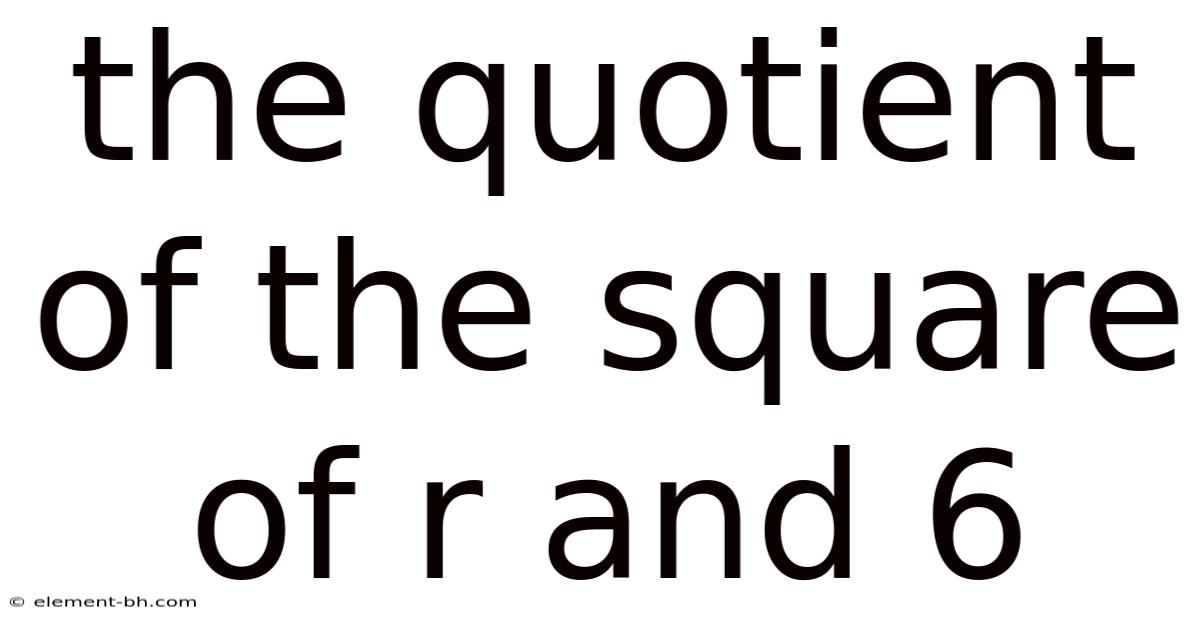
The quotient of the square of r and 6 is a simple algebraic expression that appears in many branches of mathematics and science. Written as (\frac{r^{2}}{6}) or (r^{2}/6), it combines a squared variable with a constant divisor, creating a relationship that can be interpreted in multiple ways. Understanding this expression not only strengthens algebraic manipulation skills but also opens doors to deeper insights in geometry, calculus, and physical applications Nothing fancy..
What Is the Quotient of the Square of r and 6?
Defining the Terms
The phrase the quotient of the square of r and 6 can be broken into two parts. First, the square of r means multiplying the variable (r) by itself, yielding (r^{2}). Second, the quotient indicates division, so the entire expression is (r^{2}) divided by 6. In mathematical notation, this is (\frac{r^{2}}{6}).
Writing It Mathematically
When you encounter this expression in an equation, it often appears as part of a larger formula. Take this: the area of a certain geometric figure might be expressed as (\frac{r^{2}}{6}), or a physical quantity such as energy could involve this term. Recognizing the components helps in simplifying and solving problems efficiently Turns out it matters..
Algebraic Properties
Simplification
Because 6 is a constant, the expression (\frac{r^{2}}{6}) is already in its simplest form unless additional context allows factoring. On the flip side, if (r) itself contains a factor of 6, such as (r = 6k), then (\frac{(6k)^{2}}{6} = 6k^{2}). This demonstrates how the constant divisor can interact with the variable.
Factoring and Expanding
In polynomial work, you might need to factor (\frac{r^{2}}{6}) out of a sum. Take this case: [ \frac{r^{2}}{6} + \frac{r}{3} = \frac{1}{6}(r^{2} + 2r). ] Here, factoring (\frac{1}{6}) reveals a common factor that simplifies further manipulation. Expanding works in reverse; multiplying (\frac{r^{2}}{6})
by a binomial, for example, distributes the constant factor across each term: [ \frac{r^{2}}{6}(r + 4) = \frac{r^{3}}{6} + \frac{2r^{2}}{3}. ] This distributive step is essential when simplifying complex expressions or preparing an equation for solution.
Solving Equations
When (\frac{r^{2}}{6}) appears in an equation, isolating (r) typically begins by clearing the denominator. Here's a good example: if [ \frac{r^{2}}{6} = 24, ] multiplying both sides by 6 gives (r^{2} = 144), so (r = \pm 12). If the expression is set equal to a negative number, there are no real solutions, since (r^{2}) is always non-negative.
Calculus Connections
In calculus, the expression behaves predictably under differentiation and integration. The derivative with respect to (r) is [ \frac{d}{dr}\left(\frac{r^{2}}{6}\right) = \frac{2r}{6} = \frac{r}{3}, ] while
the indefinite integral yields [ \int \frac{r^{2}}{6} , dr = \frac{r^{3}}{18} + C. ] These operations are foundational when analyzing rates of change or accumulated quantities in models where this expression represents a physical parameter, such as a scaled moment of inertia or a potential energy function Still holds up..
Geometric and Physical Interpretations
Area and Volume Scaling
The expression (\frac{r^{2}}{6}) frequently emerges as a scaling factor in geometry. For a circle of radius (r), the area is (\pi r^{2}); dividing by (6\pi) gives the area of a (60^\circ) sector. More generally, any formula where a squared length is distributed over six equal parts—such as the face area of a cube with side length (r) divided among its six faces, or the area of one equilateral triangle composing a regular hexagon—naturally produces this quotient Surprisingly effective..
Moment of Inertia
In rotational dynamics, the moment of inertia for a thin rod of mass (m) and length (r) rotating about one end is (\frac{1}{3}mr^{2}). If the system involves a composite object where mass is distributed such that the effective constant becomes (\frac{1}{6}), the term (\frac{r^{2}}{6}) (often multiplied by mass) quantifies the resistance to angular acceleration. Recognizing this structure allows physicists to quickly identify the geometric configuration from the algebraic form.
Statistical Variance
In probability, the variance of a continuous uniform distribution over an interval of length (r) is (\frac{r^{2}}{12}). When comparing two independent such variables or analyzing the mean squared error of specific estimators, the denominator often shifts to 6, making (\frac{r^{2}}{6}) a benchmark for dispersion in normalized statistical models Nothing fancy..
Common Pitfalls and Strategies
Misinterpreting the Order of Operations
A frequent error is confusing (\frac{r^{2}}{6}) with (\left(\frac{r}{6}\right)^{2} = \frac{r^{2}}{36}). The phrase "quotient of the square of (r) and 6" explicitly squares (r) before dividing. Verbalizing the steps—"square (r), then divide by 6"—helps cement the correct order.
Sign Errors in Equations
Because (r^{2} \ge 0) for all real (r), the expression (\frac{r^{2}}{6}) is never negative. Students sometimes overlook this when solving (\frac{r^{2}}{6} = k), forgetting to check that (k \ge 0) for real solutions, or neglecting the (\pm) when taking the square root Simple as that..
Calculus Constant Management
When differentiating or integrating, the constant (\frac{1}{6}) is often mishandled. It is safer to treat it as a coefficient pulled out front: (\frac{1}{6} \frac{d}{dr}(r^{2})) or (\frac{1}{6} \int r^{2} , dr), reducing the chance of arithmetic mistakes with the denominator.
Conclusion
The expression (\frac{r^{2}}{6}) is far more than a static algebraic term; it is a versatile building block that appears across the mathematical sciences. Whether factoring it from a polynomial, differentiating it to find a rate of change, integrating it to determine an accumulated quantity, or recognizing it as the geometric signature of a hexagonal sector or a specific moment of inertia, fluency with this quotient empowers problem-solving. By mastering its algebraic behavior, calculus properties, and physical interpretations, students and practitioners alike transform a simple fraction into a key that unlocks deeper structural understanding in any discipline where squared quantities are scaled by six Most people skip this — try not to..
