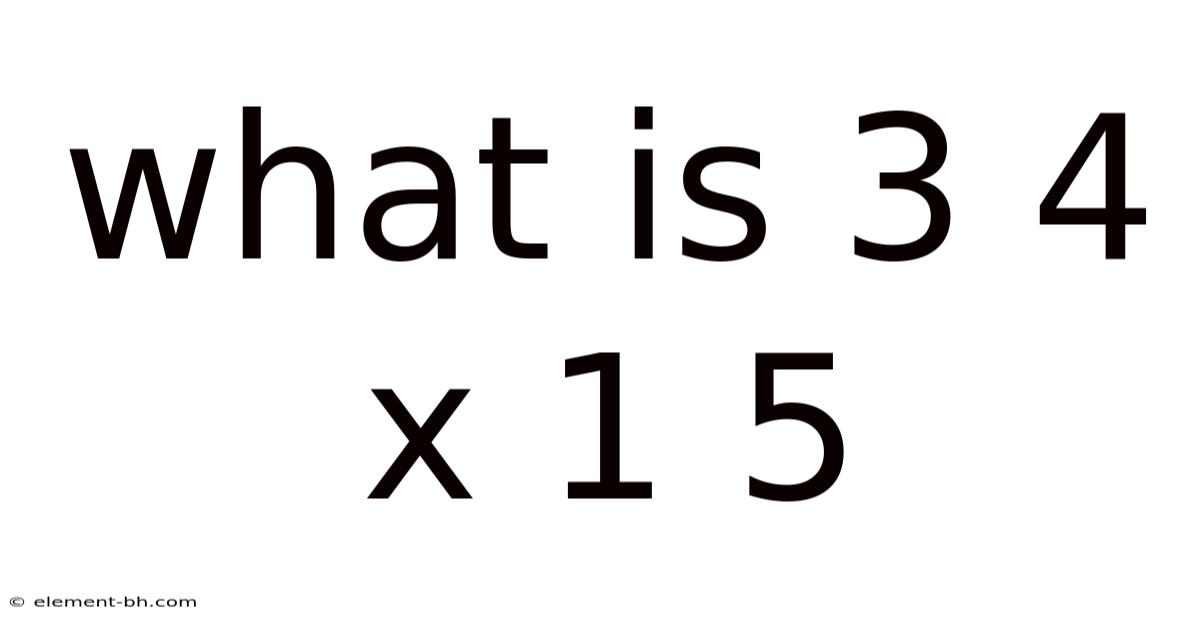
When encountering the expression 3/4 × 1/5, many learners feel a brief moment of uncertainty. Because of that, this simple multiplication of two fractions appears frequently in mathematics, from elementary school curricula to real-world applications like cooking, construction, and probability. At its core, the operation asks: "What is three-fourths of one-fifth?" The answer, derived through straightforward mathematical rules, is 3/20. That said, understanding why this works and how to apply the concept across different contexts deepens numerical fluency and builds a stronger foundation for more advanced topics. In this article, we will break down the process step by step, explore visual models that make the concept intuitive, examine common pitfalls, and provide practical examples that demonstrate why mastering fraction multiplication matters.
Understanding the Notation
Before performing the calculation, it helps
clarify what the symbols represent. Because of that, the multiplication symbol ($\times$) between them functions similarly to the word "of" in everyday language. In practice, just as "2 groups of 3 apples" implies $2 \times 3$, the expression $\frac{3}{4} \times \frac{1}{5}$ asks us to find a fractional part of a fractional part—specifically, three-fourths of one-fifth. The fraction $\frac{3}{4}$ signifies three parts out of four equal parts of a whole, while $\frac{1}{5}$ represents one part out of five equal parts. Recognizing this linguistic connection transforms an abstract symbolic manipulation into a tangible concept: we are shrinking an already small piece No workaround needed..
The Standard Algorithm: Step by Step
The procedural rule for multiplying fractions is refreshingly direct compared to addition or subtraction: multiply the numerators together to get the new numerator, and multiply the denominators together to get the new denominator. No common denominator is required.
Applying this to our expression:
- Multiply the numerators: $3 \times 1 = 3$.
- Multiply the denominators: $4 \times 5 = 20$. That said, 3. Assemble the result: $\frac{3}{20}$.
Because 3 and 20 share no common factors other than 1, the fraction is already in its simplest form. This efficiency—bypassing the need to find a Least Common Multiple—is one reason fraction multiplication is often introduced before fraction addition in curricula.
Visualizing the Operation: Area Models
For many learners, the algorithm feels like magic until it is anchored to a visual representation. The area model (or rectangle model) is the gold standard for this purpose And it works..
- Draw a rectangle representing 1 whole.
- Divide it vertically into 5 equal columns. Shade 1 column to represent $\frac{1}{5}$.
- Divide the same rectangle horizontally into 4 equal rows. You now have a grid of $5 \times 4 = 20$ identical smaller rectangles.
- Identify the target area: You need $\frac{3}{4}$ of that single shaded column. Shade 3 of the 4 rows within that first column.
- Count the result: You have shaded 3 small rectangles out of the total 20.
The visual proof is undeniable: the overlapping region constitutes exactly $\frac{3}{20}$ of the whole. This model also illustrates the Commutative Property beautifully; if you reverse the order (shade $\frac{3}{4}$ first, then take $\frac{1}{5}$ of it), the overlapping area remains identical Worth keeping that in mind..
Cross-Cancellation: Efficiency Before Calculation
While the standard algorithm works perfectly for $\frac{3}{4} \times \frac{1}{5}$, larger numbers can create unwieldy products that require heavy simplification afterward. Cross-cancellation (or simplifying before multiplying) streamlines the process by dividing out common factors diagonally between a numerator and a denominator before multiplying And that's really what it comes down to..
Consider $\frac{3}{4} \times \frac{8}{9}$:
- The numerator 3 and denominator 9 share a factor of 3 $\rightarrow$ $3 \div 3 = 1$, $9 \div 3 = 3$.
- The numerator 8 and denominator 4 share a factor of 4 $\rightarrow$ $8 \div 4 = 2$, $4 \div 4 = 1$.
- The problem simplifies to $\frac{1}{1} \times \frac{2}{3} = \frac{2}{3}$.
In our original problem ($\frac{3}{4} \times \frac{1}{5}$), cross-cancellation offers no shortcut because 3, 4, 1, and 5 share no common factors. Recognizing when a shortcut applies—and when it doesn't—is a hallmark of mathematical maturity.
Common Pitfalls and How to Avoid Them
Even with a simple rule, errors creep in. Here are the most frequent traps:
- The "Common Denominator" Reflex: Students drilled in fraction addition often instinctively convert $\frac{3}{4}$ and $\frac{1}{5}$ to $\frac{15}{20}$ and $\frac{4}{20}$, multiplying to get $\frac{60}{400}$ (which simplifies to $\frac{3}{20}$). While not wrong, it creates unnecessary work and increases arithmetic error risk.
- Cross-Multiplying Confusion: This technique is valid for comparing fractions or solving proportions (e.g., $\frac{a}{b} = \frac{c}{d}$), but it has no place in multiplication. Multiplying "across the equals sign" instead of "across the operation sign" yields nonsense.
- Adding Numerators and Denominators: The erroneous $\frac{3+1}{4+5} = \frac{4}{9}$ stems from treating the fraction as a pair of independent integers rather than a single rational number.
