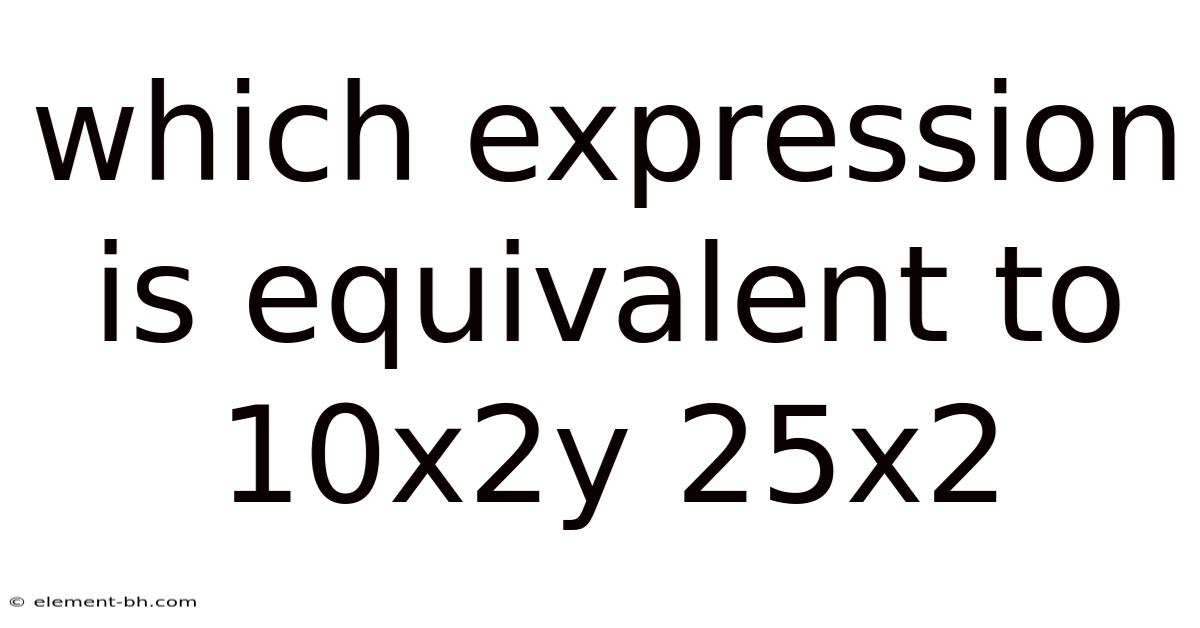
Which Expression Is Equivalent to 10x²y / 25x²?
When working with algebraic expressions, simplifying fractions is a fundamental skill that helps in solving equations, comparing terms, and understanding relationships between variables. One common type of problem involves finding an equivalent expression for a given algebraic fraction. In this case, we are asked to simplify the expression 10x²y / 25x². This problem may seem straightforward, but it requires a clear understanding of factoring, exponent rules, and simplification techniques. This article will guide you through the process step by step, ensuring you can confidently tackle similar problems.
Simplifying the Expression: Step by Step
Step 1: Identify the Numerator and Denominator
The given expression is:
$ \frac{10x^2y}{25x^2} $
Here, the numerator is 10x²y, and the denominator is 25x². To simplify this fraction, we need to break it down into its components: coefficients (numbers) and variables.
Step 2: Simplify the Coefficients
The coefficients in the numerator and denominator are 10 and 25, respectively. To simplify these, we find their greatest common divisor (GCD) Small thing, real impact..
- The GCD of 10 and 25 is 5.
- Dividing both by 5 gives:
- Numerator: $10 \div 5 = 2$
- Denominator: $25 \div 5 = 5$
So, the simplified coefficient portion is 2/5.
Step 3: Simplify the Variables
Next, we look at the variables. The numerator contains x² and y, while the denominator contains x².
-
For x²: When dividing variables with the same base and exponent, we subtract the exponents: $ \frac{x^2}{x^2} = x^{2-2} = x^0 = 1 $ Since any non-zero number raised to the power of 0 is 1, the x² terms cancel out completely Turns out it matters..
-
The y term in the numerator has no corresponding term in the denominator, so it remains as is.
Step 4: Combine the Results
After simplifying the coefficients and variables, we combine them:
$ \frac{2}{5} \cdot y = \frac{2y}{5} $
Thus, the equivalent expression to 10x²y / 25x² is 2y/5 And that's really what it comes down to..
Common Mistakes to Avoid
1. Forgetting to Cancel Variables
One common error is neglecting to cancel the x² terms. If someone overlooks this step, they might incorrectly retain x² in the final expression, leading to an answer like 2x²y/5, which is not equivalent to the original expression.
2. Incorrect Coefficient Division
Another mistake could occur when simplifying the coefficients. Here's one way to look at it: dividing 10 by 25 as 2/5 is correct, but some might mistakenly write it as 5/2 or another fraction, which would change the value entirely It's one of those things that adds up. No workaround needed..
3. Ignoring the Domain Restrictions
When simplifying expressions with variables in the denominator, it’s essential to note that the denominator cannot be zero. Here's the thing — in this case, x² ≠ 0, which means x ≠ 0. The simplified expression 2y/5 is valid only when x is not zero.
Conditions for Validity
The simplified expression 2y/5 is equivalent to the original 10x²y / 25x² only when x ≠ 0. If x = 0,
the original expression becomes undefined due to division by zero. So, the equivalence holds strictly for x ≠ 0. While the simplified form 2y/5 yields a numerical value (specifically 0) when x = 0, the original expression 10x²y / 25x² has no meaning at that point. Always state this restriction explicitly when presenting the final simplified form to maintain mathematical rigor.
Verifying the Simplification
A reliable way to confirm your work is to test the equivalence with sample values (adhering to the domain restriction). Let x = 2 and y = 3:
-
Original Expression: $ \frac{10(2)^2(3)}{25(2)^2} = \frac{10 \cdot 4 \cdot 3}{25 \cdot 4} = \frac{120}{100} = \frac{6}{5} $
-
Simplified Expression: $ \frac{2(3)}{5} = \frac{6}{5} $
Since both expressions yield the same result, the simplification is verified. You can repeat this test with any non-zero value for x and any value for y to further build confidence.
Conclusion
Simplifying algebraic fractions like 10x²y / 25x² relies on a systematic approach: reduce the numerical coefficients by their greatest common divisor, apply the laws of exponents to cancel common variable factors, and carefully track domain restrictions. By canceling the x² terms and reducing 10/25 to 2/5, we arrive at the equivalent expression 2y/5 (for x ≠ 0). Mastering these steps—separating coefficients from variables, subtracting exponents during division, and respecting the zero-denominator constraint—equips you to simplify even the most complex rational expressions with accuracy and confidence And that's really what it comes down to..
Extending the Technique to More Complex Fractions
The principles demonstrated with (\displaystyle \frac{10x^{2}y}{25x^{2}}) scale up to rational expressions that involve higher‑order powers, multiple variables, and even binomial numerators or denominators.
Example 1 – Higher Powers
Simplify (\displaystyle \frac{18x^{5}y^{3}}{30x^{2}y^{7}}).
-
Separate coefficients and variables
[ \frac{18}{30}\cdot\frac{x^{5}}{x^{2}}\cdot\frac{y^{3}}{y^{7}} ] -
Reduce the numerical fraction – the GCD of 18 and 30 is 6:
[ \frac{18}{30}=\frac{3}{5} ] -
Apply the quotient rule for exponents ((a^{m}/a^{n}=a^{m-n})):
[ \frac{x^{5}}{x^{2}}=x^{5-2}=x^{3},\qquad \frac{y^{3}}{y^{7}}=y^{3-7}=y^{-4}=\frac{1}{y^{4}} ] -
Combine the results
[ \frac{3}{5}\cdot x^{3}\cdot\frac{1}{y^{4}}=\frac{3x^{3}}{5y^{4}} ]Domain note: (y\neq0) (and, of course, (x) can be any real number because it does not appear in a denominator after simplification).
Example 2 – Binomial Numerator
Simplify (\displaystyle \frac{(a+b)^{2}}{4(a+b)}).
-
Factor out the common ((a+b)) from the numerator:
[ (a+b)^{2}= (a+b)(a+b) ] -
Cancel one factor of ((a+b)) with the denominator:
[ \frac{(a+b)(a+b)}{4(a+b)} = \frac{a+b}{4} ]Domain restriction: (a+b\neq0) (otherwise the original denominator would be zero).
These examples illustrate that the core steps—coefficient reduction, exponent subtraction, and cancellation of common factors—remain constant, regardless of the expression’s complexity Small thing, real impact..
Common Pitfalls to Watch For
| Pitfall | Why It Happens | How to Avoid It |
|---|---|---|
| Canceling terms that are added, not multiplied | Students sometimes treat (\frac{x+y}{x}=y) as valid. Worth adding: | Remember that only common factors (multiplicative) can be canceled, not terms joined by (+) or (-). But |
| Ignoring hidden factors | Expressions like (\frac{x^{2}+2x}{x}) still have a factor (x) after factoring: (\frac{x(x+2)}{x}). Now, | Always factor numerators and denominators before canceling. |
| Overlooking domain restrictions | Simplifying (\frac{x^{2}}{x^{2}}) to 1 without noting (x\neq0). Now, | Explicitly state any values that make the original denominator zero. |
| Mishandling negative exponents | Leaving (\frac{1}{x^{-3}}) as (\frac{1}{x^{-3}}) instead of rewriting as (x^{3}). | Convert negative exponents to positive ones in the final answer for clarity. |
Real‑World Applications
Simplified rational expressions appear frequently in physics, engineering, and economics. For instance:
- Physics: The formula for the period of a simple pendulum, (T = 2\pi\sqrt{\frac{L}{g}}), often requires simplifying ratios of lengths and gravitational acceleration.
- Economics: Average cost functions, ( \text{AC} = \frac{C(q)}{q}), are rational expressions that benefit from simplification to analyze marginal behavior.
- Engineering: Transfer functions in control systems are rational polynomials; reducing them helps identify poles and zeros, which dictate system stability.
In each case, a clear understanding of coefficient reduction, exponent rules, and domain restrictions ensures that the simplified model remains mathematically equivalent to the original.
Quick Reference Checklist
- Factor numerators and denominators completely.
- Separate numerical coefficients from variable factors.
- Reduce the numerical fraction using the greatest common divisor
4. Cancel common variable factors
After the numerical coefficients have been reduced, look for any variable factors that appear in both the numerator and the denominator. Because these factors are multiplied, they can be divided out, just as with numbers. To give you an idea, after factoring you might obtain
[ \frac{(x-2)(x+3)}{(x-2)(x-5)} . ]
Here the factor ((x-2)) is present in both numerator and denominator, so it can be removed, leaving
[ \frac{x+3}{x-5}, ]
with the implicit restriction (x\neq2) (and also (x\neq5) from the original denominator).
5. Write the final simplified expression
Combine any remaining factors into a single fraction or polynomial, as appropriate. If the numerator and denominator share no further common factors, the expression is in its simplest form. Be sure to preserve the original domain restrictions: any value that would have made the original denominator zero must be noted, even if that factor has been cancelled Worth keeping that in mind..
6. Verify equivalence (optional but recommended)
Choose a few values that satisfy the domain restrictions and substitute them into both the original and simplified expressions. If the results match for each test value, you can be confident that the simplification preserved the mathematical meaning Still holds up..
Final Thoughts
Simplifying rational expressions is more than a mechanical exercise; it is a foundational skill that underpins clearer analysis across mathematics, science, and engineering. By systematically factoring, separating coefficients, reducing numerical parts, and cancelling common variable factors, you transform unwieldy fractions into compact, interpretable forms. This not only makes further algebraic manipulation easier but also reveals critical insights—such as asymptotes in graphs, limiting behavior in calculus, or stability characteristics in control systems.
Mastering these steps, while remaining vigilant about domain restrictions and common pitfalls, equips you to handle increasingly complex problems with confidence. Whether you are streamlining a physics formula, optimizing an economic cost function, or reducing a transfer function for system design, the disciplined approach outlined here will serve as a reliable guide Worth knowing..
