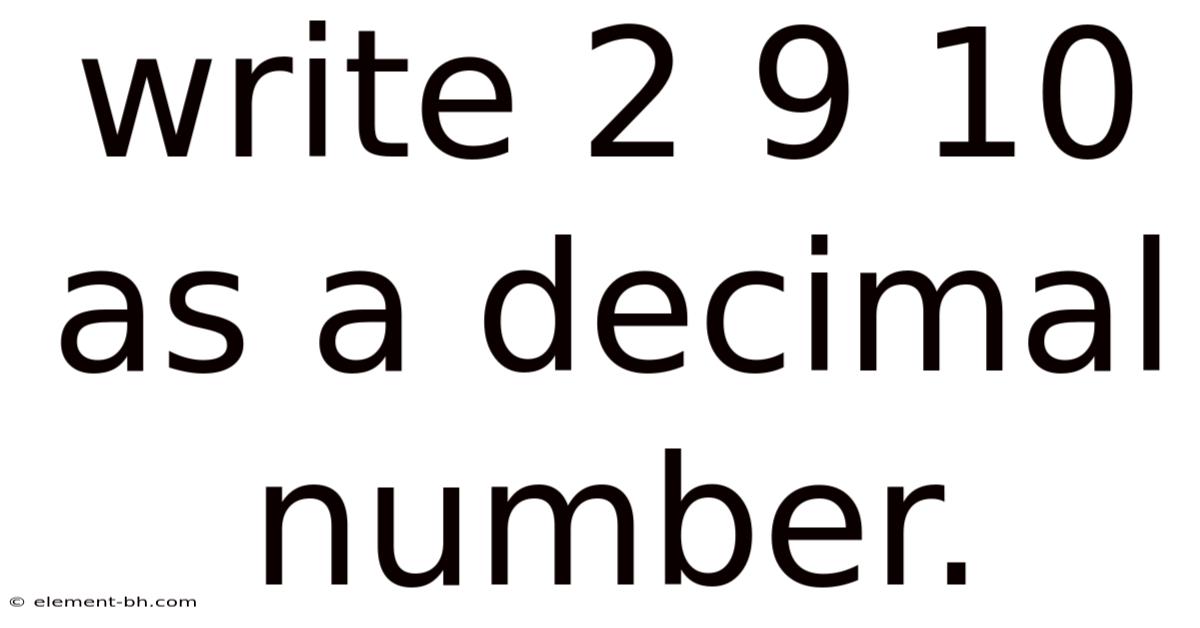
Understanding how to convert mixed numbers into decimal form is a fundamental skill in mathematics that bridges the gap between fractional representation and the base-ten system we use daily. When faced with the expression 2 9 10, the standard mathematical interpretation is the mixed number $2 \frac{9}{10}$ (two and nine-tenths). Writing this as a decimal number results in 2.9. While the answer itself is concise, the underlying concepts of place value, fraction equivalence, and conversion methods are essential for building numerical fluency. This article explores the step-by-step process, the mathematical reasoning behind the conversion, various methods to achieve the result, and practical applications to solidify your understanding.
Understanding the Components: Mixed Numbers and Decimals
Before diving into the conversion, it is crucial to identify the parts of the given expression. The notation "2 9 10" represents a mixed number, which consists of two distinct parts:
- The Whole Number Part: The digit 2. This represents two complete units.
- The Fractional Part: The fraction $\frac{9}{10}$ (nine-tenths). This represents a part of a whole unit, specifically 9 parts out of 10 equal parts.
A decimal number is simply another way to write fractions where the denominator is a power of ten (10, 100, 1000, etc.). Day to day, the decimal point separates the whole number part (to the left) from the fractional part (to the right). The first position to the right of the decimal point is the tenths place, the second is the hundredths place, and so on.
Because the denominator of our fraction is 10, the conversion is direct: the numerator (9) goes directly into the tenths place Not complicated — just consistent..
Method 1: The Place Value Method (Fastest Approach)
This is the most intuitive method for fractions with denominators of 10, 100, or 1000. It relies entirely on understanding the base-10 place value system.
Step 1: Write the whole number. Start by writing the whole number part: 2.
Step 2: Place the decimal point. Add a decimal point to the right of the whole number: 2.
Step 3: Analyze the denominator. The fraction is $\frac{9}{10}$. The denominator is 10. This tells you that the fractional part occupies the tenths place (the first spot to the right of the decimal).
Step 4: Write the numerator in the correct place value slot. The numerator is 9. Place this digit in the tenths place. Result: 2.9
Why this works: In our number system, $0.1 = \frac{1}{10}$, $0.2 = \frac{2}{10}$, ..., $0.9 = \frac{9}{10}$. That's why, $2 + 0.9 = 2.9$ Small thing, real impact..
Method 2: Converting to an Improper Fraction First
This method is universally applicable to any mixed number, regardless of the denominator. It reinforces the relationship between mixed numbers and improper fractions.
Step 1: Convert the mixed number to an improper fraction. Multiply the whole number (2) by the denominator (10), then add the numerator (9). $ (2 \times 10) + 9 = 20 + 9 = 29 $ Keep the same denominator (10). The improper fraction is $\frac{29}{10}$ Surprisingly effective..
Step 2: Divide the numerator by the denominator. A fraction bar represents division. So, $\frac{29}{10}$ means $29 \div 10$ Simple, but easy to overlook. But it adds up..
Step 3: Perform the division. Dividing by 10 shifts the decimal point one place to the left. $ 29 \div 10 = 2.9 $ (Think of 29 as 29.0; moving the decimal left once gives 2.9).
This method confirms the result and is the standard algorithm used when denominators are not powers of ten (e.g., converting $2 \frac{3}{4}$ requires dividing 11 by 4).
Method 3: Fraction Expansion (Making the Denominator a Power of 10)
If the denominator were something other than 10, 100, or 1000 (like 4, 5, 8, 20, 25), you would use this method to force the denominator to become a power of ten. Since our denominator is already 10, this step is trivial but excellent for practice The details matter here..
Step 1: Identify the target denominator. We want the denominator to be 10, 100, 1000, etc. It is already 10 It's one of those things that adds up. Took long enough..
Step 2: Determine the multiplier. What do you multiply 10 by to get 10? 1.
Step 3: Multiply numerator and denominator by that multiplier. $ \frac{9 \times 1}{10 \times 1} = \frac{9}{10} $
Step 4: Write as a decimal. Since the denominator is 10 (one zero), the decimal has one digit after the point. The numerator is 9. Decimal: 0.9
Step 5: Combine with the whole number. $2 + 0.9 = \mathbf{2.9}$
Deep Dive: The "Why" Behind the Decimal Point
To truly master this, one must understand why the decimal point moves. Our number system is positional. The value of a digit depends entirely on its position relative to the decimal point Worth keeping that in mind..
| Position | Place Value | Fraction Equivalent | Power of 10 |
|---|---|---|---|
| Tens | 10 | $10/1$ | $10^1$ |
| Ones | 1 | $1/1$ | $10^0$ |
| Decimal Point | |||
| Tenths | 0.1 | $1/10$ | $10^{-1}$ |
| Hundredths | 0.01 | $1/100$ | $10^{-2}$ |
It sounds simple, but the gap is usually here That's the part that actually makes a difference..
When we write 2.9, we are mathematically expressing: $ (2 \times 1) + (9 \times 0.1) $ $ = 2 + \frac{9}{10} $ $ = 2 \frac{9}{10} $
The decimal point is not just a dot; it is the anchor that defines where the "ones" place ends and the "tenths" place begins. And without it, "29" would be twenty-nine. Now, with it, "2. 9" is two and nine-tenths.
Common Pitfalls and How to Avoid Them
Even simple conversions can trip up students. Here are the most frequent errors when writing 2 9 10 as a decimal number:
1. Misplacing the Decimal Point (Writing 29.0 or 0.29)
- Error: Writing 29 (ignoring the fraction) or 29.0 (treating the fraction as a whole number) or 0.29 (treating the denominator as 100).
- **Fix
