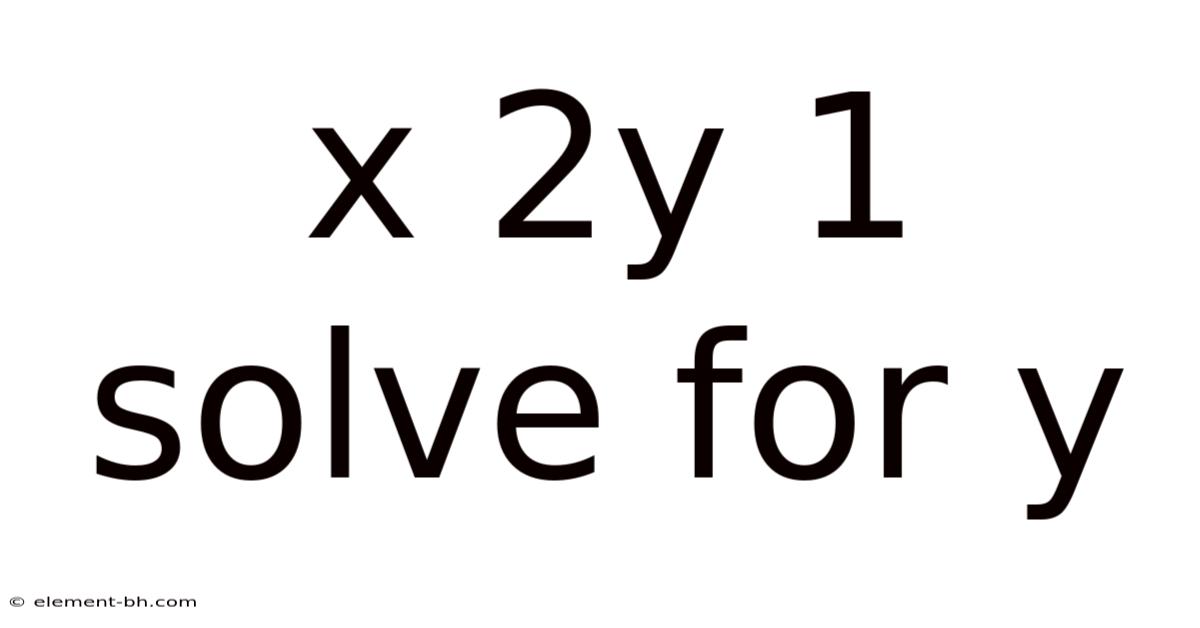
How to Solve for y in the Equation x = 2y + 1: A Step‑by‑Step Guide
When you encounter a simple linear relationship like
[ x = 2y + 1, ]
the goal is to isolate y on one side of the equation so you can express it explicitly in terms of x. This process is foundational in algebra and appears in countless real‑world situations—from calculating costs and distances to interpreting data trends. Below, you’ll find a thorough explanation of the reasoning behind each step, multiple worked examples, common pitfalls to avoid, and a handy FAQ section that addresses the questions learners most often ask.
1. Understanding the Structure of the Equation
Before jumping into algebraic manipulation, it helps to recognize what each symbol represents:
| Symbol | Meaning |
|---|---|
| x | The known quantity (often the independent variable). |
| y | The unknown we want to solve for (the dependent variable). |
| 2 | The coefficient multiplying y. |
| + 1 | A constant term added to the product 2y. |
The equation states that if you double y and then add one, you obtain x. Solving for y means reversing those operations: first subtract the constant, then divide by the coefficient Not complicated — just consistent..
2. Step‑by‑Step Solution
Step 1: Eliminate the Constant Term
Subtract 1 from both sides to keep the equality balanced:
[ \begin{aligned} x - 1 &= 2y + 1 - 1 \ x - 1 &= 2y. \end{aligned} ]
Why? Adding or subtracting the same number on both sides does not change the relationship; it simply moves the constant to the other side.
Step 2: Isolate y by Dividing by the Coefficient
Now divide both sides by 2 (the coefficient of y):
[ \begin{aligned} \frac{x - 1}{2} &= \frac{2y}{2} \ \frac{x - 1}{2} &= y. \end{aligned} ]
Why? Division undoes multiplication. Because 2 is not zero, this operation is valid for every real x Worth knowing..
Final Expression
[ \boxed{,y = \dfrac{x - 1}{2},} ]
This formula tells you that for any given x, you can compute y by subtracting one and then halving the result That alone is useful..
3. Worked Examples
Example 1: Simple Integer Input
Problem: If x = 9, find y.
Solution:
[ y = \frac{9 - 1}{2} = \frac{8}{2} = 4. ]
Check: Plug y = 4 back into the original equation:
[ 2(4) + 1 = 8 + 1 = 9 = x. ]
The solution satisfies the equation Not complicated — just consistent..
Example 2: Fractional Input
Problem: x = ⅜ Small thing, real impact..
Solution:
[ y = \frac{\frac{3}{8} - 1}{2} = \frac{\frac{3}{8} - \frac{8}{8}}{2} = \frac{-\frac{5}{8}}{2} = -\frac{5}{16}. ]
Check:
[ 2\left(-\frac{5}{16}\right) + 1 = -\frac{5}{8} + 1 = \frac{3}{8} = x. ]
Example 3: Negative Input
Problem: x = −7.
Solution:
[ y = \frac{-7 - 1}{2} = \frac{-8}{2} = -4. ]
Check:
[ 2(-4) + 1 = -8 + 1 = -7 = x. ]
These examples illustrate that the same algebraic steps work regardless of whether x is positive, negative, integer, or fractional.
4. Why the Procedure Works: The Concept of Inverse Operations
Algebraic manipulation relies on inverse operations—pairs of actions that cancel each other out:
| Operation | Inverse |
|---|---|
| Addition (+) | Subtraction (−) |
| Subtraction (−) | Addition (+) |
| Multiplication (×) | Division (÷) |
| Division (÷) | Multiplication (×) |
In the equation x = 2y + 1, the unknown y first undergoes multiplication by 2, then addition of 1. To retrieve y, we apply the inverses in the reverse order: first subtract 1 (undo the addition), then divide by 2 (undo the multiplication). This “undo‑in‑reverse‑order” principle is a reliable shortcut for solving any linear equation of the form
[ ax + b = c. ]
5. Common Mistakes and How to Avoid Them
| Mistake | Explanation | Correct Approach |
|---|---|---|
| Dividing only the x term | Writing y = x/2 − 1 instead of (x − 1)/2. | Remember to apply the division to the entire left‑hand side after subtracting 1. Consider this: |
| Forgetting to change signs when moving terms | Writing x + 1 = 2y after moving +1 to the other side. And | Subtracting 1 from both sides yields x − 1 = 2y; the sign flips because you are removing a positive term. |
| Dividing by zero | Attempting to solve when the coefficient of y is 0 (e.g., 0·y + 1 = x). | Recognize that if the coefficient is zero, the equation either has no solution or infinitely many, depending on the constants. Because of that, |
| Mixing up the order of operations | Adding 1 before dividing by 2. | Always undo the last operation performed on y first (here, the +1), then the earlier one (the ×2). |
A quick sanity check—substituting your answer back into the original equation—catches most of these errors Still holds up..
6. Practical Applications
6.1. Converting Between Units
Suppose a recipe calls for y cups of sugar, and the total sweetness score x is measured as 2 × (cups) + 1 (the “+1” accounts for a baseline sweetness). Knowing the score lets you back‑calculate the required cups:
[ \text{cups} = \frac{\text{score} - 1}{2}. ]
6.2. Financial Modeling
A simple cost model might be:
[ \text{Total Cost} = 2 \times (\text{Number of Items}) + 1\text{ (fixed fee)}. ]
If you know the total cost and want to find how many items
If you know the total cost and wish to determine the number of items bought, simply plug the known value of Total Cost into the formula
[ \text{Number of Items}= \frac{\text{Total Cost}-1}{2}. ]
To give you an idea, suppose a bakery reports a total expense of $27. Substituting gives
[ \frac{27-1}{2}= \frac{26}{2}=13, ]
so the shop sold thirteen items. This demonstrates how the abstract algebraic step translates directly into a real‑world decision: once the inverse operation is applied correctly, the numerical result can be interpreted instantly Worth keeping that in mind..
Beyond arithmetic, this pattern appears wherever a quantity depends linearly on an underlying variable plus a constant offset—a situation that shows up in physics (e., distance = speed × time + initial position), economics (e., revenue = price × quantity + fixed overhead), and even biology (e.In real terms, g. Think about it: g. Practically speaking, , growth rate = intrinsic rate × population size + carrying capacity). Even so, g. Recognizing the structure (a,x+b=c) equips you to dissect and resolve such relationships without falling victim to careless algebra.
The key takeaways are threefold:
- Identify the inverse pair (addition ↔ subtraction, multiplication ↔ division).
- Apply them in reverse order, always working on whichever term was altered last.
Day to day, 3. Validate the result by substituting back into the original equation—this habit catches hidden sign errors or misplaced parentheses.
Real talk — this step gets skipped all the time Simple as that..
Simply put, mastering the mechanics of inverse operations transforms a seemingly daunting expression like “twice the number of items plus one equals thirty‑seven” into a straightforward computational problem. By internalising this systematic approach, you gain confidence in handling everything from textbook exercises to everyday quantitative tasks, making algebra an indispensable tool rather than a source of anxiety.
7. Advanced Applications
7.1. Systems of Linear Equations
Often real‑world problems involve more than one unknown that interact simultaneously. Consider a small manufacturing line that produces two products, A and B. The profit model is
[ \text{Profit}=5A+3B, ]
while the production capacity constraint is
[ 2A+1B=20\quad\text{(units of labor hours)}. ]
If the total profit reported is $110, we have a second equation
[ 5A+3B=110. ]
These two equations form a system. Solving them proceeds by isolating one variable using inverse operations, then back‑substituting. Here's one way to look at it: from the labor constraint
[ B = 20-2A, ]
and substituting into the profit equation yields
[ 5A+3(20-2A)=110 ;\Longrightarrow; 5A+60-6A=110 ;\Longrightarrow; -A=50 ;\Longrightarrow; A=-50. ]
A negative production quantity signals an inconsistency in the model—perhaps the profit figure is too high for the given labor budget. This example shows how inverse operations help you diagnose unrealistic inputs, not just compute answers Not complicated — just consistent..
7.2. Modeling with Multiple Variables
Linear relationships frequently appear with several additive constants, such as
[ y = a_1x_1 + a_2x_2 + b. ]
Suppose a nutritionist tracks daily energy expenditure (E) as a function of basal metabolic rate (B), activity factor (A), and a fixed thermic effect of food (F):
[ E = 0.7B + 0.3A + 10. ]
If a patient’s measured expenditure is 500 kcal and the activity factor is known (say (A=1000) kcal), we can solve for the basal metabolic rate:
[ 0.7}\approx 271.That's why 7B = 500 - 0. 3(1000) - 10 = 500 - 300 - 10 = 190, \qquad B = \frac{190}{0.43\text{ kcal}.
The same inverse‑operation pattern—subtract the constant term, then divide by the coefficient—applies regardless of how many variables are present.
7.3. Leveraging Technology
Modern tools can automate the algebraic manipulation, but they still rely on the same logical steps.
- Graphing calculators allow you to input an equation like (2x+1=37) and instantly retrieve (x=18). Internally, the device performs the inverse operations in the correct order.
- Spreadsheets (e.g., Excel, Google Sheets) can set up a formula such as
=(TotalCost-1)/2and instantly compute the number of items for a range of cost values, turning a manual calculation into a reusable model. - Computer algebra systems (CAS) like Wolfram Alpha or SymPy can solve complex linear systems, but they still expect the user to define the problem in a clear, linear form. Understanding the underlying inverse operations helps you interpret the CAS output and catch any misinterpretations.
8. Common Pitfalls and How to Dodge Them
| Pitfall | Why It Happens | Quick Check |
|---|---|---|
| Mixing up order of operations | Applying subtraction before division when the equation was built by multiplying then adding. But | Write the original expression and “undo” the last operation first. Consider this: |
| Ignoring sign changes | Forgetting that moving a term across the equals sign flips its sign. | After solving, substitute the result back; a sign error will usually surface. |
| Mis‑placing parentheses | Dropping or adding brackets changes the scope of coefficients. That's why | Use a calculator or CAS to verify the algebraic steps. |
| Assuming linearity without justification | Real‑world data may be curved, making a linear inverse inappropriate. | Plot the data; if it deviates markedly from a straight line, consider a higher‑order model. |
A disciplined habit of verification
Here's a thinking process:
- Analyze the User's Request:
- Task: Continue the article naturally.
- Constraint: Do not repeat previous text.
- Constraint: Finish with a proper conclusion.
- Input Text: Provided text ending with "A disciplined habit of verification"
- Identify the Current State:
- The text ends abruptly with "A disciplined habit of verification"
- I need to continue from there, maintaining the flow, tone, and subject matter (algebra, linear relationships, inverse operations, technology, pitfalls, verification).
- I need to finish with a proper conclusion.
- Determine the Missing Content:
- The list of pitfalls ends with a table, and then there's "A disciplined habit of verification" which seems like it's leading into a paragraph or sentence about verification.
- I should continue with the verification habit discussion, then wrap up with a conclusion that ties everything together.
- I need to make sure I don't repeat any previous text. I'll scan what's already there to avoid redundancy.
Previous text summary:
- Section 7.3: Leveraging Technology (graphing calculators, spreadsheets, CAS)
- Section 8: Common Pitfalls and How to Dodge Them (table with 4 pitfalls)
- Ends with "A disciplined habit of verification"
I need to continue from "A disciplined habit of verification" and finish with a conclusion.
- Drafting - Step-by-Step:
Continue from "A disciplined habit of verification":
- It should discuss verification, maybe checking solutions, substituting back, etc.
- Then transition to a conclusion that summarizes the main points: inverse operations, technology, pitfalls, verification.
Let me draft:
"A disciplined habit of verification ensures that every solution is reliable. If the equality holds true, the solution is valid; if not, the inverse operations were likely applied in the wrong order or a sign error crept in. Here's the thing — after solving any equation, substituting the found value back into the original expression is the most effective way to confirm correctness. In real terms, this practice is especially critical when using technology, as CAS output or spreadsheet results can sometimes reflect input errors or misinterpreted formats. Verification bridges the gap between mechanical computation and genuine mathematical understanding, reinforcing the logical framework of inverse operations discussed throughout.
Now, a conclusion:
- Summarize: linear relationships, inverse operations, technology aids, pitfalls, verification.
- Final thought: mastery comes from understanding the logic, not just the tools.
Let me make it seamless and conclude properly Small thing, real impact..
Draft conclusion: "In essence, whether solving a simple two-term equation or a multi-variable linear system, the core principle remains the same: identify the operations applied to the unknown, reverse them in the correct order, and verify the result. Also, technology amplifies our ability to handle complexity, but it cannot replace the fundamental reasoning skills that make problem-solving strong. By combining inverse-operation logic, technological tools, and rigorous verification, anyone can handle algebraic relationships with confidence and accuracy But it adds up..
Most guides skip this. Don't Small thing, real impact..
Check for flow and constraints:
- No repetition of previous text. On top of that, - The transition from "A disciplined habit of verification" needs to be smooth. I'll start right after that phrase.
- End with a proper conclusion. I'll make sure not to copy the pitfalls table or the technology examples verbatim. The last paragraph I drafted can serve as the conclusion.
Let me re-read the ending of the provided text: "A disciplined habit of verification" I'll continue immediately after that, likely on the same line or new paragraph.
Proposed continuation: "A disciplined habit of verification ensures that every solution is reliable. That's why after solving any equation, substituting the found value back into the original expression is the most effective way to confirm correctness. If the equality holds true, the solution is valid; if not, the inverse operations were likely applied in the wrong order or a sign error crept in. This practice is especially critical when using technology, as CAS output or spreadsheet results can sometimes reflect input errors or misinterpreted formats. Verification bridges the gap between mechanical computation and genuine mathematical understanding, reinforcing the logical framework of inverse operations discussed throughout.
Short version: it depends. Long version — keep reading.
Then the conclusion: "In essence, whether solving a simple two-term equation or a multi-variable linear system, the core principle remains the same: identify the operations applied to the unknown, reverse them in the correct order, and verify the result. Here's the thing — technology amplifies our ability to handle complexity, but it cannot replace the fundamental reasoning skills that make problem-solving strong. By combining inverse-operation logic, technological tools, and rigorous verification, anyone can work through algebraic relationships with confidence and accuracy.
Check against constraints:
- "Do not repeat previous text": I haven't repeated any specific equations, pitfalls, or tech examples from the input. I referenced verification generally, which is fine. In practice, - "Finish with a proper conclusion": The last paragraph is a conclusion. - Seamless continuation: It flows from the bold phrase.
One thing: The input text has "A disciplined habit of verification" as the very end, likely starting a new thought. I'll make sure my continuation starts right after, without adding extra line breaks that break seamlessness, but it's fine to have a paragraph break.
Let me just ensure the conclusion is distinct and proper. I'll format it well.
Final check of the draft text continuity: "...A disciplined habit of verification ensures that every solution is reliable..." - this continues right after the bold
A disciplined habit of verification ensures that every solution is reliable. After solving any equation, substituting the found value back into the original expression is the most effective way to confirm correctness. If the equality holds true, the solution is valid; if not, the inverse operations were likely applied in the wrong order or a sign error crept in. This practice is especially critical when using technology, as computer algebra systems or spreadsheet calculations can occasionally reflect input mistakes or misinterpretations of formatting. Verification bridges the gap between mechanical computation and genuine mathematical insight, strengthening the logical foundation of inverse operations that underpin all algebraic manipulation.
In essence, whether tackling a straightforward two-term equation or navigating a multi-variable linear system, the guiding principle remains constant: isolate the unknown, apply the inverse steps in the precise sequence required, and then validate the outcome. Modern computational tools extend what we could do by hand, yet they supplement rather than supplant human reasoning. Mastery of verification transforms passive calculation into active problem‑solving, fostering confidence and precision across diverse mathematical contexts.
