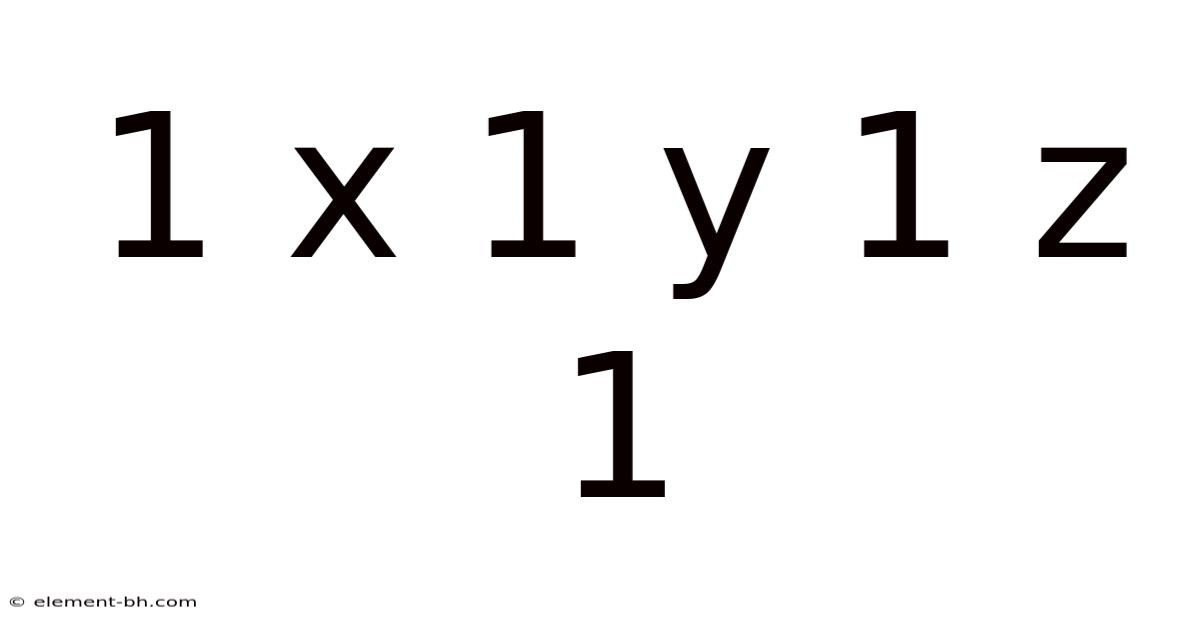
Understanding the Expression 1 × 1 × y × 1 × z × 1: Simplification, Rules, and Meaning
The expression 1 x 1 y 1 z 1 looks confusing at first glance, but it is simply a chain of multiplication involving the number 1 and the variables x, y, and z. When simplified correctly using the identity property of multiplication, the entire expression reduces to just xyz. In this article, you will learn how to simplify expressions like this step by step, why the ones disappear, and how to avoid the most common algebra mistakes students make Most people skip this — try not to..
This is where a lot of people lose the thread.
What Does "1 x 1 y 1 z 1" Actually Mean?
In algebra, when a number and a variable sit next to each other without a visible symbol, multiplication is implied. So a string like 1 x 1 y 1 z 1 is usually written more clearly as:
1 · x · 1 · y · 1 · z · 1
That is seven factors multiplied together: four ones and three variables. Because multiplication is commutative (the order does not change the product) and associative (the grouping does not change the product), you can rearrange the factors however you like:
1 · 1 · 1 · 1 · x · y · z
Simplifying Step by Step
Step 1: Group the numbers together
Pull all the numerical coefficients to the front:
(1 × 1 × 1 × 1) × (x × y × z)
Step 2: Multiply the ones
1 × 1 × 1 × 1 = 1
Step 3: Reattach the variables
1 × x × y × z = xyz
By convention, mathematicians write the coefficient 1 in front of a variable silently. So 1xyz is always written as xyz. The final simplified answer is:
1 · x · 1 · y · 1 · z · 1 = xyz
Why the Ones Disappear: The Identity Property
The reason this works is one of the most important rules in all of mathematics: the multiplicative identity property. It states that any number or variable multiplied by 1 stays exactly the same.
- 1 × 7 = 7
- 1 × a = a
- 1 × xyz = xyz
Multiplying by 1 is a "do nothing" operation. That is why algebra teachers encourage students to drop coefficients of 1 entirely. Writing 1x instead of x is not wrong, but it is not simplified, and unsimplified work makes harder problems harder to read Took long enough..
The same logic applies in reverse. When you see a lone variable such as y, its coefficient is understood to be 1:
y = 1 · y
This hidden 1 becomes essential later when you combine like terms. Here's one way to look at it: x + x is really 1x + 1x = 2x Practical, not theoretical..
Common Mistakes to Avoid
Mistake 1: Adding instead of multiplying. Some students read "1 x 1 y 1 z 1" as addition and answer 1 + 1 + y + 1 + z + 1. The letter x (or the × symbol) signals multiplication, not addition.
Mistake 2: Thinking the answer is 1. Multiplying everything does not "erase" the variables. Only multiplying by 1 leaves a factor unchanged; the variables x, y, and z must remain in the result Simple as that..
Mistake 3: Confusing xyz with x + y + z. The product xyz and the sum x + y + z are completely different. If x = 2, y = 3, z = 4, then xyz = 24, while x + y + z = 9.
Mistake 4: Assuming variables equal 1. A variable with no written number does not mean the variable is 1. It means its coefficient is 1, but its value is unknown until you are told what it is Most people skip this — try not to..
Practice Examples
Try these on your own, then check the answers:
- 1 · a · 1 · b → ab
- 1 · 1 · 1 · m → m
- 1 · x · 2 · y · 1 · z → 2xyz (the 2 stays because it is not 1)
- 1 · p · 1 · p · 1 · p → p³ (repeated variables become exponents)
- 1 · x · 1 · x · 1 · y → x²y
Notice the pattern:
Notice the pattern: every simplification above uses the same three moves, in the same order.
- Multiply the numbers. Any coefficient other than 1 survives and gets combined with the rest.
- Delete the ones. Each factor of 1 vanishes by the identity property.
- Collect the letters. Repeated variables become powers, and different variables are written in alphabetical order after the coefficient.
In one sentence: numbers multiply, ones vanish, letters pile up as exponents.
Applying the Pattern to Longer Expressions
Once you see the three moves, you can simplify much longer strings without thinking:
1 · 3 · a · 1 · b · 2 · a
Numbers: 1 × 3 × 1 × 2 = 6. Letters: a · a = a², plus b. Result: 6a²b
1 · x · 1 · y · 1 · z · 4 · 1 · y → 4 · x · y · y · z = 4xy²z
1 · (−1) · m · 1 · n
1 · (−1) · m · 1 · n → −m
The three moves apply just the same: the numbers multiply to −1, the ones disappear, and the letter m remains. The result is simply −m That's the whole idea..
Conclusion
Algebra becomes significantly less intimidating
when you understand why the invisible 1 matters and how repeated variables accumulate. Instead of seeing a jumble of numbers and letters, you begin to recognize a product waiting to be simplified. The rules are consistent, so the process becomes less guesswork and more method Easy to understand, harder to ignore. But it adds up..
And yeah — that's actually more nuanced than it sounds.
This consistency is encouraging. That said, mistakes may still happen, but they become easier to catch because the framework is clear. Day to day, once you can break a complicated expression into coefficients, ones, and variables, you can apply the same thinking again and again. You can verify each step, test substitutions, and watch how the expression responds Practical, not theoretical..
At the end of the day, simplifying algebraic expressions is a foundational skill that makes later mathematics more approachable. It does not make math easier by magic; it makes math easier by removing confusion. And removing confusion is exactly what turns intimidating symbols into useful tools. With patience and practice, algebra becomes not just something you can handle, but something you can reason through confidently Still holds up..
The true power of this pattern emerges when it is applied to expressions that include parentheses or negative signs, as these are the elements that often cause confusion. Consider an expression like 1 · 2 · (a + b). Here, the three moves adapt smoothly. First, multiply the numbers: 1 × 2 = 2. The ones vanish. Still, then, the letters are collected, but the parentheses indicate that the 2 must be distributed to both a and b. So the result is 2a + 2b. This demonstrates that the core logic remains intact; it simply extends to handle grouped terms.
Similarly, negative signs are managed with the same discipline. In an expression such as 1 · (−3) · x · 1 · y, you first multiply the numbers: 1 × (−3) × 1 = −3. The ones disappear. The letters x and y are collected. The result is −3xy. That's why the negative sign is just another coefficient, and the process handles it without any special rules. This methodical approach prevents the common error of misplacing a negative sign or forgetting to distribute a coefficient No workaround needed..
It sounds simple, but the gap is usually here.
What this framework ultimately teaches is a form of algebraic hygiene. Each simplification becomes a small, logical deduction—a step toward clarity rather than a leap into uncertainty. Now, it encourages a student to see an expression not as a static puzzle, but as a dynamic structure that can be systematically deconstructed and rebuilt. This is the bridge from arithmetic, where the goal is a single number, to algebra, where the goal is a simpler, more useful representation of a relationship.
That's why, mastering this initial pattern is more than just learning to simplify; it is about developing a mathematical mindset. It is the first step in learning to think with symbols instead of just about numbers. Now, the confidence gained from this clarity is invaluable, as it forms the bedrock upon which all subsequent algebraic concepts—from factoring to solving equations—are built. With a firm grasp of these foundational moves, the language of algebra ceases to be a foreign tongue and begins to feel like a native one, spoken with fluency and precision Most people skip this — try not to. That's the whole idea..
