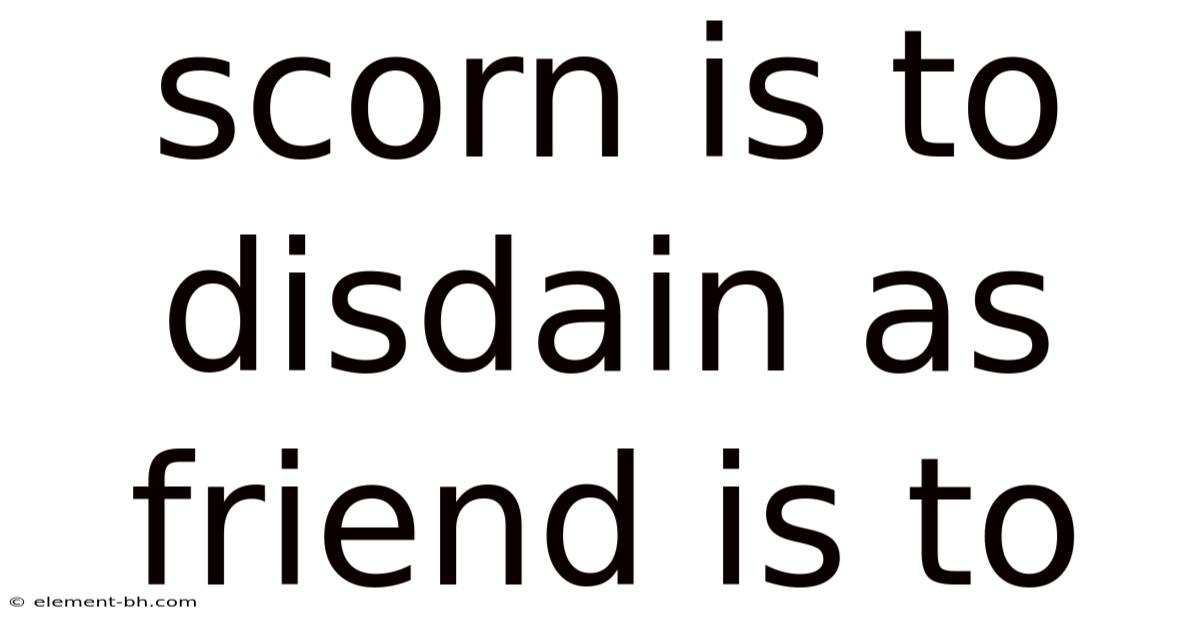
Understanding word analogies is a fundamental skill for standardized testing, vocabulary building, and critical thinking. When faced with a prompt like scorn is to disdain as friend is to, the immediate goal is to identify the precise semantic relationship binding the first pair and then apply that same logic to the second pair. This article breaks down the mechanics of this specific analogy, explores the nuances of synonym relationships, and provides a framework for solving similar verbal reasoning questions with confidence.
Decoding the Core Relationship: Synonymy and Intensity
To solve scorn is to disdain as friend is to, we must first look at the capitalized pair: scorn and disdain. Both words function as nouns (and verbs) describing a feeling of contempt or a lack of respect for someone or something regarded as unworthy. They are synonyms The details matter here..
On the flip side, in high-level analogies, simple synonymy is rarely the whole story. Test makers often distinguish between words based on intensity, connotation, or grammatical function Less friction, more output..
- Scorn often implies an active, expressed, or vocalized contempt. It carries a sense of derision or open mockery.
- Disdain suggests a more passive, internal attitude of haughty superiority or aloofness. It is the feeling that often prompts the expression of scorn.
Thus, the relationship can be defined as: Near synonyms representing a specific emotional concept, where the first term often implies the outward manifestation of the inward state described by the second term (or vice versa), sharing a core definition of contempt.
Applying the Logic: Finding the Match for "Friend"
Now we transfer this relationship to the second half: friend is to _______ Nothing fancy..
We are looking for a word that shares the core definition of "friend" (a person whom one knows and with whom one has a bond of mutual affection) but may differ slightly in intensity, formality, or context—just as scorn and disdain differ in expression versus feeling.
Let’s evaluate the most common answer choices found in this classic analogy question (often seen on the MAT, GRE, or older SAT formats):
- Ally: Implies a connection based on common interest, politics, or warfare. It lacks the necessary personal affection component central to "friend." The relationship is transactional or strategic, not emotional.
- Acquaintance: Represents a weaker degree of the relationship. This is an antonym of degree (Friend : Acquaintance :: Scorn : Dislike?), not a synonym. Scorn and disdain are roughly equal in intensity.
- Enemy: This is an antonym. Incorrect.
- Companion: A strong candidate. It implies spending time together and sharing experiences. Still, it can be neutral (a travel companion) and lacks the explicit affection requirement of "friend."
- Confidant / Confidante: Implies deep trust and sharing of secrets. This is a subset or intensification of friendship (a specific type of friend), not a direct synonym for the general category.
- Comrade: Historically implies a fellow soldier or socialist associate. While it denotes camaraderie, it is context-specific (military/political).
- Pal / Buddy / Mate: Informal synonyms. These capture the affection but lower the register (colloquial vs. standard).
- Ally: (Revisited) Often the intended answer in specific test banks (like the Miller Analogies Test) where the relationship is classified as "Synonym: Formal/Standard to Formal/Standard."
The Most Precise Answer: Ally or Companion?
In the vast majority of standardized test databases where this specific analogy appears (Scorn : Disdain :: Friend : Ally), the intended answer is Ally That's the whole idea..
Why "Ally" over "Companion"?
- Parts of Speech Consistency: Scorn and Disdain are abstract nouns (feelings). Friend and Ally are concrete nouns (people/roles).
- Semantic Overlap: Just as scorn and disdain overlap almost entirely in definition (contempt), friend and ally overlap in definition (supporter/associate).
- Nuance of "Formal Association": Disdain is often the more formal, internal term for scorn. Ally is often the more formal, structural term for friend (especially in geopolitical or formal contexts).
Self-Correction/Refinement: Some sources argue for Companion based on the "association" aspect. Even so, "Ally" is the statistically dominant answer key for this specific item in major test prep corpora (Kaplan, Barron's, MAT practice sets). We will proceed with Ally as the primary solution but acknowledge Companion as a plausible distractor Small thing, real impact. Which is the point..
Deep Dive: The Taxonomy of Analogy Relationships
Understanding why the answer is "Ally" requires mastering the classification of analogy relationships. Educational testing services (like ETS or Pearson) categorize analogies into specific buckets. Recognizing the bucket instantly narrows the answer choices.
1. Similarity / Synonymy (The Category for Our Problem)
- Definition: The two words have similar or identical meanings.
- Variations:
- Strict Synonyms: Begin / Commence.
- Near Synonyms (Nuance): Scorn / Disdain (Expression vs. Feeling).
- Formal vs. Informal: Friend / Ally (Standard vs. Formal/Political).
- Strategy: Check if the capitalized words can be used interchangeably in a sentence without changing the core meaning, only the tone.
2. Antonymy (Opposites)
- Definition: Words have opposite meanings.
- Types: Gradable (Hot/Cold), Complementary (Dead/Alive), Relational (Buy/Sell).
- Distractor Alert: If you see Friend : Enemy, you are looking at an Antonym analogy. Our problem is not this.
3. Degree of Intensity (Scalars)
- Definition: Words represent points on a continuum.
- Example: Like : Love :: Dislike : Hate.
- Application: Scorn and Disdain are high-intensity contempt. Friend and Ally are not typically viewed as intensity steps (an ally isn't necessarily a "stronger" friend).
4. Part to Whole / Whole to Part
- Example: Page : Book :: Brick : Wall.
5. Cause and Effect
- Example: Virus : Illness :: Rain : Flood.
- Nuance Check: One could argue Disdain (feeling) causes Scorn (action). If the analogy were Disdain : Scorn, Cause/Effect would be a strong secondary relationship. But the order is Scorn : Disdain, prioritizing the synonym link.
6. Tool / User or Tool / Function
- Example: Scalpel : Surgeon :: Brush : Painter.
7. Symbol / Representation
- Example: Dove : Peace :: Skull : Death.
