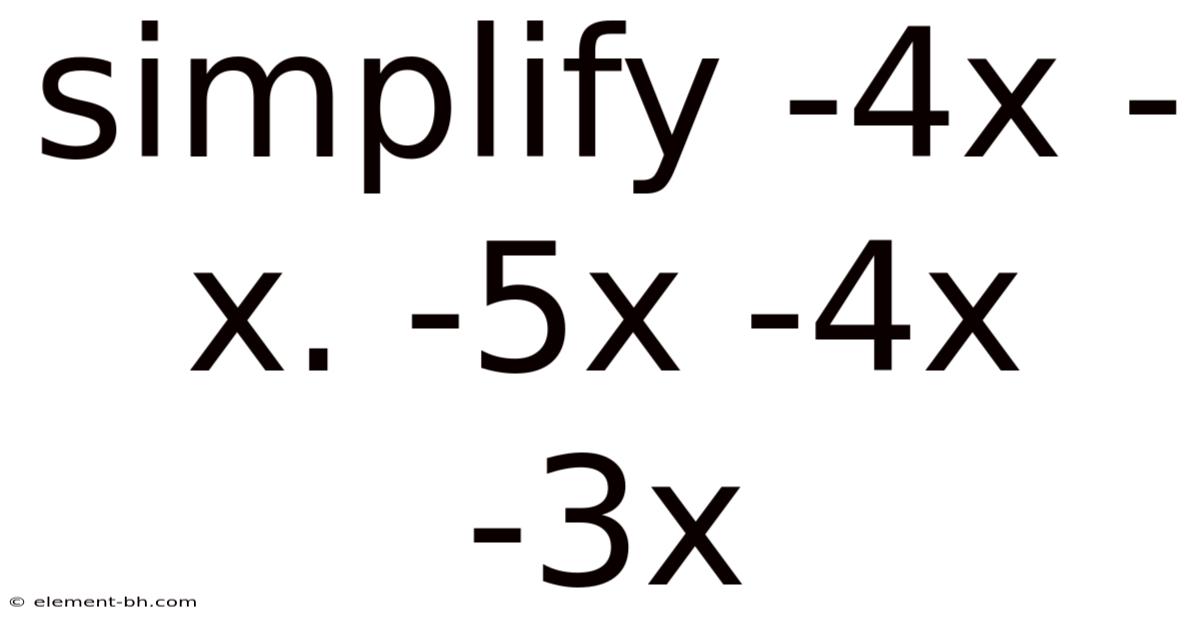
Simplifying -4x - x is a quick exercise in combining like terms, and the correct result is -5x. This expression often appears in pre-algebra and algebra lessons, especially when students are learning how to handle negative coefficients and variable terms. Here's the thing — if you are choosing between -5x, -4x, and -3x, the answer is -5x because both terms are negative and both contain the same variable. Understanding why this is true is more valuable than memorizing the answer, since the same reasoning applies to many other algebraic expressions.
This is the bit that actually matters in practice Simple, but easy to overlook..
Understanding the Expression -4x - x
The expression -4x - x contains two terms: -4x and -x. These are called like terms because they have the same variable part, which is x. In algebra, like terms can be combined by adding or subtracting their coefficients. Still, the coefficient is the number in front of the variable. For -4x, the coefficient is -4. For -x, the coefficient is -1, because x is the same as 1x, and the negative sign makes it -1x The details matter here..
So the expression can be rewritten as:
-4x - 1x
Now combine the coefficients:
-4 + (-1) = -5
Keep the variable x, and the simplified expression becomes:
-5x
This is why -4x - x = -5x. In real terms, the variable does not change; only the number of x-terms changes. You started with four negative x-terms and then subtracted one more x-term, leaving five negative x-terms.
Step-by-Step Simplification
Here is a clear process you can follow whenever you simplify expressions like -4x - x:
- Identify like terms. Look for terms that have the same variable and exponent. In -4x - x, both terms contain x to the first power.
- Rewrite hidden coefficients. Change -x to -1x so the coefficient is visible.
- Combine the coefficients. Add -4 and -1 to get -5.
- Attach the variable. Place x beside the new coefficient to get -5x.
- Check your work. Substitute a value for x to verify that the original and simplified expressions are equivalent.
As an example, let x = 2. The original expression becomes:
-4(2) - 2 = -8 - 2 = -10
The simplified expression becomes:
-5(2) = -10
Both give the same result, so -5x is correct Simple, but easy to overlook..
Why the Answer Is Not -4x or -3x
When students see -4x - x, they sometimes choose -4x because they focus only on the first term and ignore the second. That is incorrect because the -x still affects the total value. Others choose -3x because they accidentally treat -x as positive x and calculate -4 + 1 = -3. That mistake comes from misreading the subtraction sign But it adds up..
The expression -4x - x means “negative four x minus one x.”
That wording matters: subtracting a positive x is the same as adding a negative x. So the expression can be viewed as -4x + (-1x), which makes the negative coefficient of the second term explicit. Think about it: once both terms are written this way, the operation is straightforward addition of coefficients: -4 + (-1) = -5. The variable remains x, so the result is -5x.
A Number-Line View
A number line can make the reasoning more intuitive. Since the variable part never changed, the final term is -5x. You land at -5. Think about it: start at -4 on the number line, which represents the coefficient of the first term. Then move 1 unit farther left, because subtracting x is like subtracting 1x. This visual model reinforces the same rule: when the signs point in the same negative direction, the coefficients add together and keep the negative sign Simple as that..
Similar Expressions to Practice
The same method works for many related problems:
- -7y - 2y = -9y, because -7 + (-2) = -9.
- -6m + m = -5m, because m is 1m, and -6 + 1 = -5.
- 3a - 8a = -5a, because 3 + (-8) = -5.
- -2b - 4b - b = -7b, because -2 + (-4) + (-1) = -7.
In each case, the variable stays the same while the coefficients combine. The sign of the final coefficient depends on whether the negative terms outweigh the positive terms Practical, not theoretical..
A Common Misstep to Avoid
One frequent error is to subtract the coefficients but forget the sign of the second term. Take this case: someone might calculate -4 - 1 = -3 by mistakenly treating the subtraction as -4 + 1. To avoid this, rewrite every term with its sign clearly before combining. Writing -4x - x as -4x - 1x removes ambiguity and helps prevent sign mistakes.
Another useful check is to substitute a simple value such as x = 1. So naturally, the original expression becomes -4(1) - 1 = -5, and the simplified expression becomes -5(1) = -5. When both forms produce the same value, the simplification is consistent.
Conclusion
Simplifying -4x - x is a matter of recognizing like terms, making hidden coefficients visible, and combining them carefully. The two terms share the variable x, and their coefficients are -4 and -1. Consider this: adding those coefficients gives -5, so the simplified expression is -5x. That's why more importantly, the process teaches a reliable habit: identify like terms, track the signs, combine coefficients, and verify the result. That habit extends far beyond this single expression and provides a solid foundation for simplifying more complex algebraic expressions The details matter here. Surprisingly effective..
