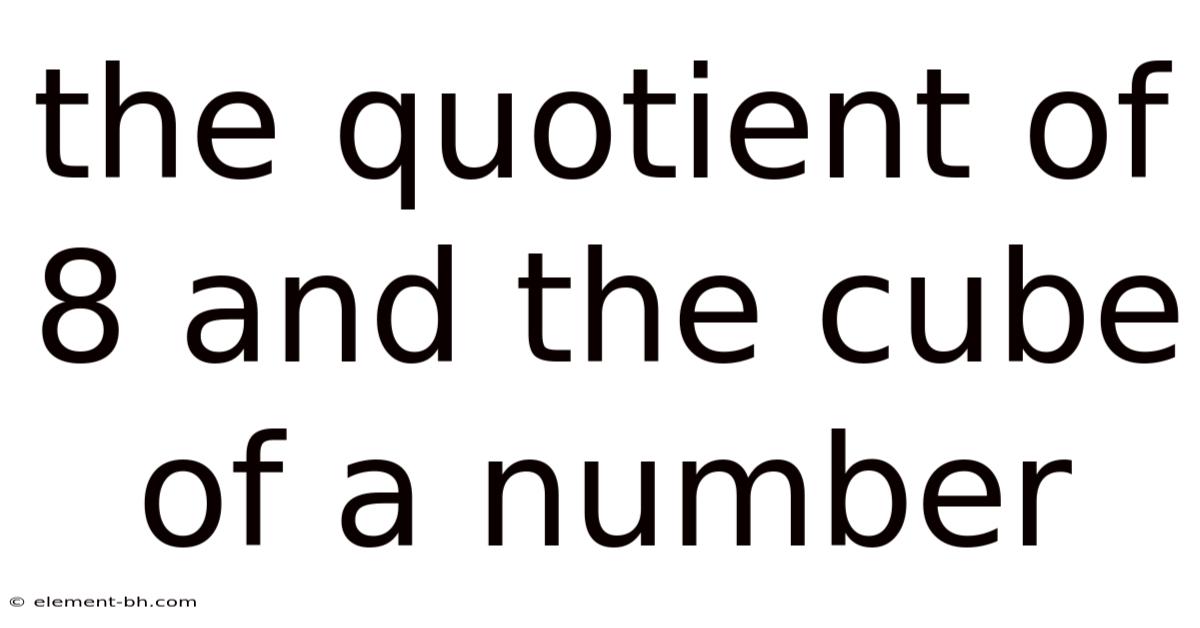
The phrase "the quotient of 8 and the cube of a number" is one of those algebra expressions that trips up many learners, not because the math is hard, but because translating everyday words into mathematical symbols requires careful attention to order and meaning. In this complete guide, you will learn exactly how to convert the quotient of 8 and the cube of a number into a clean algebraic expression, why the order of the terms matters so much, and how to evaluate it for any value you choose. By the end, this concept will feel completely natural.
People argue about this. Here's where I land on it Most people skip this — try not to..
Introduction to the Expression
In mathematics, we constantly move between two languages: the language of words and the language of symbols. When a problem says "the quotient of 8 and the cube of a number," it is describing a division operation in plain English. Our job is to rewrite that description as an algebraic expression using a variable to stand in for the unknown number.
The complete answer is:
8 ÷ x³, which is written more cleanly as 8/x³ Less friction, more output..
Here, x represents "a number," and x³ represents "the cube of a number." This single expression captures the entire meaning of the phrase. Everything else in this article explains why this is correct and how to work with it confidently It's one of those things that adds up..
Breaking Down the Key Vocabulary
Before translating, it helps to define each word precisely. Misunderstanding even one term can flip the answer upside down.
- Quotient: The result of a division. The word "quotient" is your signal that a division sign or fraction bar belongs in the expression.
- 8: A constant, meaning a fixed value that never changes.
- The cube of a number: The number raised to the third power. "Cube" always means an exponent of 3, so a number x cubed is x³.
- A number: An unknown quantity, which we represent with a variable such as x, n, or a.
Once these definitions are clear, the phrase stops looking intimidating and starts looking like a simple recipe.
Step-by-Step Translation
Translating verbal phrases becomes easy when you follow a consistent process. Here is the reliable method for this particular expression Most people skip this — try not to..
- Identify the operation. The word "quotient" tells you the operation is division.
- Find the first quantity. In "the quotient of 8 and...," the number 8 comes first, so 8 is the dividend (the number being divided).
- Find the second quantity. The phrase "the cube of a number" comes second, so it is the divisor (the number you divide by). This becomes x³.
- Assemble the expression. Place the dividend over the divisor: 8/x³.
The structure "the quotient of A and B" always translates to A ÷ B, or A/B. This fixed pattern is worth memorizing because it removes all guesswork.
Why Order Is Everything
Division is not commutative, meaning the order of the numbers changes the result. This is the single most common mistake students make with quotient problems.
- "The quotient of 8 and the cube of a number" = 8/x³
- "The quotient of the cube of a number and 8" = x³/8
These two expressions are completely different. And in the first, 8 is on top; in the second, x³ is on top. Always match the order in which the quantities are spoken to the order in which they appear in the fraction.
Evaluating the Expression with Real Numbers
An expression becomes much more concrete when you substitute actual values. Let's evaluate 8/x³ for several numbers so you can see the pattern.
- If x = 1, then x³ = 1, so 8/1 = 8.
- If x = 2, then x³ = 8, so 8/8 = 1.
- If x = 4, then x³ = 64, so 8/64 = 1/8 (or 0.125).
- If x = 0.5, then x³ = 0.125, so 8/0.125 = 64.
Notice how the output shrinks rapidly as x grows, because you are dividing a fixed number by an ever-larger cube. This behavior is characteristic of what mathematicians call a rational function Simple, but easy to overlook..
The Scientific and Mathematical Explanation
The expression 8/x³ is a type of rational expression, which is any expression written as one polynomial divided by another. The numerator here is the constant 8, and the denominator is the monomial x³ Practical, not theoretical..
One critical detail deserves special attention: the domain restriction. Because division by zero is undefined, the value x = 0 must be excluded. Consider this: in formal notation, the domain is all real numbers except zero, written as x ≠ 0. If you ever substitute 0 into this expression, the result is undefined, not zero.
Not the most exciting part, but easily the most useful.
The cube function x³ also carries a useful property: it preserves sign. A positive number cubed stays positive, and a negative number cubed stays negative. This means 8/x³ is positive when x is positive and negative when x is negative. Take this: if x = −2, then x³ = −8, and 8/(−8) = −1.
Graphing the Idea
If you were to plot 8/x³, you would see two separate branches of a curve, one in the region where x is positive and one where x is negative, with a vertical asymptote shooting up near x = 0. That gap in the graph is the visual representation of the domain restriction. This is why the expression is never allowed to touch the y-axis Worth keeping that in mind..
Common Mistakes to Avoid
Even after understanding the concept, small errors can creep in. Watch out for these frequent pitfalls:
- Reversing the order, writing x³/8 instead of 8/x³.
- Forgetting the exponent, writing 8/x instead of 8/x³. Remember that "cube" specifically means the third power.
- Ignoring the domain, and accidentally allowing x = 0.
- Misreading "cube" as "square." A square uses an exponent of 2, while a cube uses an exponent of 3.
Keeping these distinctions in mind will protect you from the most typical mistakes on homework and exams.
Frequently Asked Questions
What does "the cube of a number" mean exactly? It means the number multiplied by itself three times. For a number x, the cube is x · x · x = x³.
Is the answer 8/x³ or x³/8? It is 8/x³. The phrase "quotient of 8 and..." places 8 first, so 8 is the numerator Simple as that..
Can the number be zero? No. If x = 0, the denominator becomes 0, and division by zero is undefined. So x must be any nonzero number.
**
What happens if the number is negative? The expression handles negative inputs naturally because the cube of a negative number is negative. To give you an idea, if x = −3, then x³ = −27, and the quotient becomes 8/(−27) = −8/27. The result is negative, consistent with the rule that a positive divided by a negative yields a negative.
How would I write "the quotient of the cube of a number and 8"? That phrasing reverses the order: the cube of the number (x³) comes first, making it the numerator. The expression would be x³/8. Word order is everything in translating English to algebra Easy to understand, harder to ignore. But it adds up..
Can this expression be simplified further? Not unless you have a specific value for x. Since 8 and x³ share no common variable factors, 8/x³ is already in its simplest algebraic form Surprisingly effective..
Real-World Context: Inverse Cube Relationships
While 8/x³ is a clean algebraic exercise, the structure k/x³ (where k is a constant) appears frequently in physics and engineering. It describes an inverse cube law, where an effect diminishes proportionally to the cube of the distance Small thing, real impact..
A classic example is the magnetic field strength (B) along the axis of a magnetic dipole. If you double your distance from the magnet (x becomes 2x), the field doesn't just halve—it becomes 1/8th as strong (since (2x)³ = 8x³). At a distance x from the center, the field strength drops off roughly as 1/x³. The constant 8 in our expression would represent the specific strength of the source at a unit distance. Understanding how rapidly the denominator grows explains why magnetic fields, dipole radiation, and certain gravitational anomalies become negligible very quickly as you move away from the source.
Not the most exciting part, but easily the most useful Small thing, real impact..
Practice Problems
Test your translation skills with these variations. Answers are at the bottom The details matter here..
- Write the expression for: "The quotient of 27 and the cube of y."
- Write the expression for: "The cube of the quotient of z and 2." (Hint: Parentheses matter here.)
- Evaluate 8/x³ for x = ½.
- True or False: The expression 8/x³ is defined for all real numbers.
Answers:
- 27/y³
- (z/2)³ or z³/8 (The quantity z/2 is cubed, not just z.)
- 64 (Since (½)³ = ⅛, then 8 ÷ ⅛ = 8 × 8 = 64.)
- False (It is undefined at x = 0.)
Conclusion
Translating "the quotient of 8 and the cube of a number" into 8/x³ is more than a vocabulary exercise; it is a lesson in precision. It forces us to respect the order of operations, honor the domain restrictions that keep our mathematics valid, and recognize the structural patterns—like the inverse cube relationship—that govern both abstract algebra and the physical universe. Whether you are simplifying a rational expression on a whiteboard or calculating the falloff of a magnetic field in a lab, the logic remains the same: the denominator dictates the behavior, and the cube ensures that behavior changes drastically with every step away from the origin.
