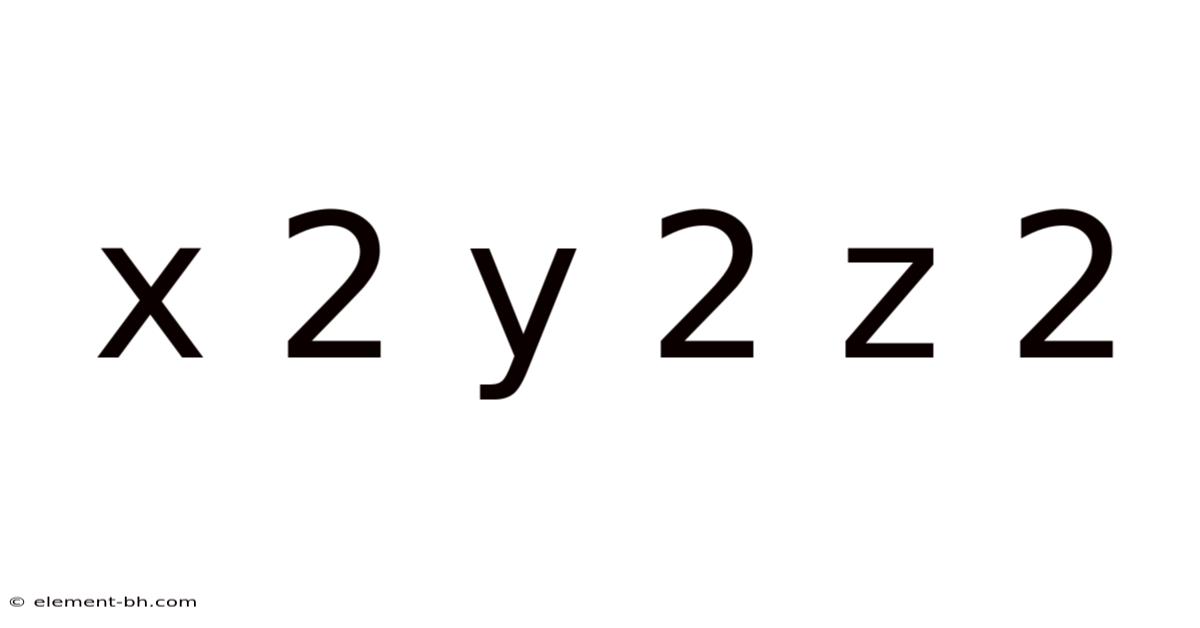
Understanding the Expression x × 2 × y × 2 × z × 2: A thorough look to Multiplication with Variables
Introduction
The expression x × 2 × y × 2 × z × 2 may initially appear as a simple string of letters and numbers, but it holds significant mathematical value when explored thoroughly. This leads to this article will break down the meaning of this expression, demonstrate how to simplify it, and explore its practical applications across various fields. Whether you are a student learning algebra or a professional seeking to understand more complex mathematical concepts, this guide will provide you with a clear and comprehensive understanding of how to work with such expressions Simple, but easy to overlook..
At its core, x × 2 × y × 2 × z × 2 represents a product of four variables—x, y, z—each multiplied by the number 2. On the flip side, this pattern of multiplication by 2 repeatedly is a common technique used in mathematics to represent doubling, scaling, or combining quantities. Understanding this expression is fundamental not only for algebra but also for real-world problem-solving where quantities are often multiplied by factors to determine final results Worth keeping that in mind..
Understanding the Expression
Before diving into the simplification process, let's examine what x × 2 × y × 2 × z × 2 actually means. In mathematics, multiplication is commutative and associative, which means the order in which we perform the operations does not affect the final result. We can rearrange the expression to group similar terms together for easier understanding No workaround needed..
Breaking down the expression into its components:
- x represents any variable (a placeholder for a specific value)
- y represents another variable
- z represents a third variable
- 2 is the constant factor that appears multiple times
The expression can be rewritten as: 2 × 2 × 2 × x × y × z
This grouping highlights that we are multiplying three instances of 2 together, which equals 8. So, the entire expression simplifies to 8 × x × y × z or 8xyz.
Step-by-Step Simplification
Let's walk through the simplification process systematically to ensure clarity and accuracy. When we have multiple instances of the same number being multiplied, we can combine them first before multiplying by the variables Still holds up..
Step 1: Group the Constant Terms
The constant terms in our expression are 2, 2, and 2. Multiplying these together gives: 2 × 2 × 2 = 8
Step 2: Multiply by the Variables
Now we multiply this result by the variables x, y, and z: 8 × x × y × z = 8xyz
Step 3: Final Simplified Form
The simplified form of x × 2 × y × 2 × z × 2 is 8xyz. This is a much more compact and easier-to-work-with representation of the original expression.
Mathematical Significance
The expression x × 2 × y × 2 × z × 2 is more than just a simplified equation—it represents a fundamental concept in mathematics: scaling. In algebra, multiplying by a constant (in this case, 8) is a type of linear transformation that scales all values by that factor. This concept is crucial in various mathematical disciplines.
Why This Matters in Mathematics
-
Linear Combinations: This expression demonstrates how to create linear combinations of variables, where each variable is multiplied by a coefficient. In our case, each variable is multiplied by 8, making it a uniform scaling factor.
-
Polynomial Representation: In polynomial terms, 8xyz is a homogeneous polynomial of degree 3 (since the sum of the exponents is 3). Understanding how to simplify such expressions is essential for working with polynomials.
-
Coefficient Analysis: The number 8 serves as a coefficient for the product xyz. This is important in physics and engineering where coefficients often represent constants of proportionality.
Real-World Applications
Understanding how to simplify expressions like x × 2 × y × 2 × z × 2 has practical applications across many fields. Here are some examples:
In Business and Economics
Companies often use such expressions to calculate total costs or revenues. To give you an idea, if x represents the number of units produced, y represents the price per unit, and z represents the number of customers, then 8xyz could represent a scaled total value. The factor of 8 might represent a growth factor or a multiplier applied to the base quantity.
Not the most exciting part, but easily the most useful.
In Physics and Engineering
When calculating forces, energies, or other physical quantities, expressions involving multiple variables and constants are common. To give you an idea, in fluid dynamics, the flow rate might be proportional to the cross-sectional area (x), velocity (y), and depth (z), all multiplied by a constant factor of 8 to account for specific conditions.
In Computer Science
Programming often involves expressions that combine variables with constants. In algorithm analysis, the time complexity might be expressed as 8n³ where n is the input size. Simplifying such expressions helps in understanding the efficiency of algorithms.
Common Mistakes to Avoid
While working with expressions like x × 2 × y × 2 × z × 2, there are several common errors that students and professionals often make:
- Forgetting to Multiply All Terms: One might accidentally multiply only some of the 2s, leading to an incorrect result like 4xyz instead of 8xyz.
- Incorrect Order of Operations: Though multiplication is commutative, make sure to ensure all terms are multiplied together before considering any addition or subtraction.
- Misplacing the Variables: In some cases, variables might be confused with constants, especially when they are not clearly defined.
- Overlooking Parentheses: If the expression were written differently (e.g., x × (2 × y) × 2 × z), the order of operations would change. Always pay attention to how parentheses are used.
Conclusion
The expression x × 2 × y × 2 × z × 2 may look simple at first glance, but it encapsulates fundamental mathematical principles that are widely applicable. By simplifying it to 8xyz, we gain a clearer understanding of how variables and constants interact in multiplication. This concept of scaling and combining variables is essential in mathematics, science, and everyday problem-solving The details matter here..
Honestly, this part trips people up more than it should.
Remember that
Remember that mastering the ability to simplify and interpret mathematical expressions is a fundamental skill that supports critical thinking and problem-solving across disciplines. In real terms, whether you are analyzing financial models, designing engineering systems, or developing software algorithms, the capacity to recognize and manipulate such expressions efficiently becomes invaluable. Also, by internalizing these basic principles, you equip yourself with the tools to tackle more complex real-world challenges with confidence and precision. Worth adding: in an era where quantitative reasoning is increasingly essential, the clarity gained from simplifying expressions like x × 2 × y × 2 × z × 2 to 8xyz demonstrates the power of mathematical abstraction in translating abstract concepts into concrete solutions. When all is said and done, this skill not only enhances academic performance but also empowers individuals to make informed decisions in their professional and personal lives.
No fluff here — just what actually works.
